Blog / AI-SDLC
What Is AI-SDLC And The Software Factory Model


Nasssir Khan
Head of Product Marketing & GTM
TL;DR
AI-SDLC treats requirements, architecture, implementation, testing, and governance as a connected system rather than isolated phases. The value comes from preserving context across every handoff so decisions remain traceable from business intent to production code.
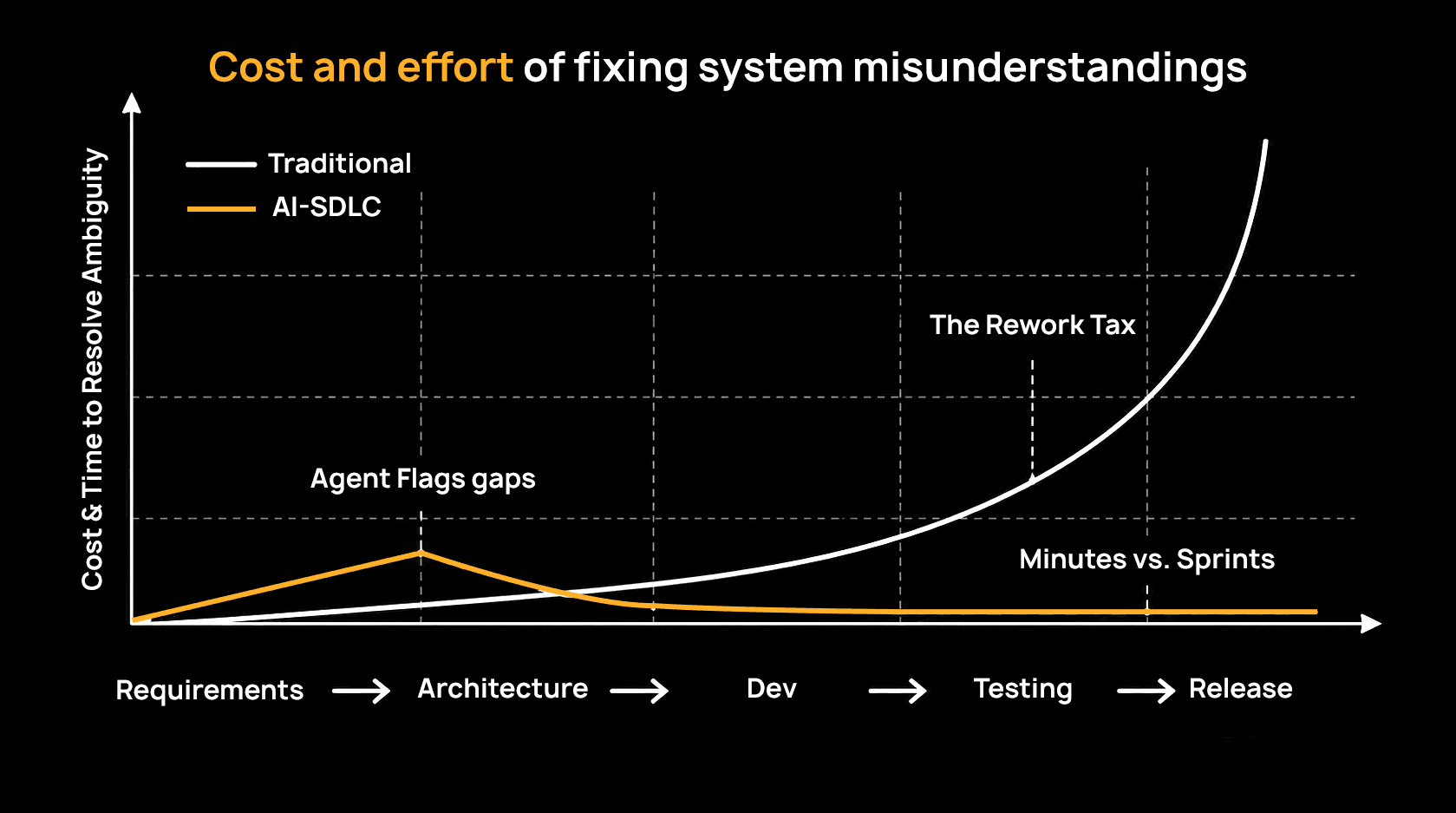
Most engineering inefficiency comes from ambiguity, documentation drift, and lost institutional knowledge, not from writing code. AI-SDLC shifts clarification to the earliest stages, where fixing misunderstandings takes minutes rather than sprints.
The Software Factory model standardizes how work moves through delivery pipelines, making quality a property of the process. Consistent workflows, shared artifacts, and enforced controls reduce dependence on individual expertise and tribal knowledge.
Structured context is the foundation of successful AI-assisted development. Agents perform reliably when they operate against requirements, constraints, blueprints, and acceptance criteria rather than isolated prompts or incomplete documentation.
Governance is embedded into the workflow itself through approvals, policy checks, and audit trails. This allows organizations to maintain continuous accountability and compliance rather than reconstructing evidence after releases occur.
AI-SDLC is fundamentally a scalability strategy for complex software systems. Organizations adopt it because coordinating people, decisions, and knowledge across large engineering programs becomes the limiting factor long before coding capacity does.
The Shift From Development Lifecycle To Delivery System
AI tooling in software development has moved well past autocomplete. Engineers across enterprises now deal with AI agents that touch requirements, architecture, testing, and deployment decisions, not just the lines of code inside a function body. The question organizations face isn't whether to involve AI in delivery; it's how to keep every stage of that delivery auditable, consistent, and tied back to the original business intent.
Softwareforge's 2026 AI Coding Impact Benchmark Report found that organizations implementing AI across software delivery workflows saw the strongest gains when improvements extended beyond code generation into planning, requirements, and delivery coordination. The report highlights that reducing rework and maintaining alignment across the delivery lifecycle contributed significantly to overall productivity gains, reinforcing that the largest impact comes from connecting requirements, architecture, governance, and implementation rather than accelerating coding tasks alone.
AI-SDLC addresses that gap by treating AI agents as first-class participants throughout the software development lifecycle , rather than optional assistants at a single step. The Software Factory model provides AI-SDLC with its operational structure: standardized workflows, shared context, and enforced governance, so that delivery quality is a property of the process, not of whoever happens to be working on a given ticket.
In the sections below, we cover how traditional SDLC breaks down under modern engineering load, what changes in an AI-SDLC workflow, what a Software Factory actually is, how the Software Factory platform operationalizes these concepts for regulated enterprises, and where governance fits into all of it.
AI-SDLC is an engineering workflow in which AI agents participate in structured activities across the full software lifecycle from requirements analysis and architecture design through test generation, code review, and deployment checks.
The practical difference comes down to what the agent receives. A developer typing "add JWT auth to the orders API" is prompted. A coding agent receiving a work order that includes the requirement ID, relevant architecture blueprint sections, security constraints, and acceptance criteria is operating within a structured context. Context engineering, the deliberate design of what information an LLM receives to complete a task correctly, is what separates a prototype from a production workflow.
Phase | Traditional SDLC | AI-SDLC |
Requirements | Human-authored tickets, often post-hoc | Agent parses business intent, generates structured specs with acceptance criteria |
Architecture | Design meetings; ADRs written after the fact | Agent generates blueprints from requirements; constraints are captured before code starts |
Development | Engineers write code, optionally with autocomplete | Coding agents receive structured work orders with full upstream context |
Testing | QA writes tests manually, usually after development | Agent generates test suites from specifications in parallel with code |
Governance | Compliance reviewed at release gates | Policy checks run continuously; audit trail is built into every artifact |
Why Traditional SDLC Faces New Challenges
Three problems compound as organizations scale. Below are the challenges described in brief:
Documentation Drift: Architecture Decision Records get written once and never updated. Confluence pages describe a system that no longer exists, forcing developers to validate information directly from the codebase because documentation can no longer be trusted.
Knowledge Silos: Critical system knowledge often resides with individual engineers rather than within shared systems. When the engineer who designed the authentication layer or deployment pipeline leaves, the context leaves with them, creating months of reverse-engineering effort.
Coordination Overhead: Misaligned requirements between product, engineering, security, and business teams often remain hidden until late in delivery. A feature that passes development may fail security review, or a QA engineer may discover that "support multiple file types" meant four formats to one team and eleven to another. Resolving ambiguity during code review costs far more than resolving it during requirements, yet traditional SDLC provides no structural mechanism to address it earlier.
How Traditional SDLC Works Today
The traditional SDLC assumes that information can flow reliably among requirements, architecture, implementation, testing, and operations via documents, tickets, and human communication. Though that assumption often holds true in small projects, it becomes the primary source of delivery risk in large enterprise programs.
Most organizations already have project managers, architecture reviews, sprint planning ceremonies, change management boards, security approvals, and release workflows. The problem is that the artifacts created during those activities rarely remain synchronized as delivery progresses.
How Teams Handle Requirements And Planning Today
Consider a modernization initiative involving payments, identity, and customer management services. A business requirement may start as:
"Support delegated administration for enterprise customers."
That requirement typically moves through several transformations:
Business Requirement → Epic → Architecture Design → Jira Stories → Pull Requests → Test Cases → Release Notes |
Each transformation introduces interpretation.
The architecture team may define delegated administration through role hierarchies and scoped permissions. Engineering may implement role assignments. QA may test permission inheritance. Security may focus on access boundaries. All teams are working from the same requirement, but often through different artifacts maintained in different systems.
A project manager can track delivery status across those systems, but answering a question as simple as "Which production services are affected if this requirement changes today?" becomes surprisingly difficult.
Traditional SDLC rarely maintains those relationships as structured data. The answer usually depends on meetings, tribal knowledge, and manual investigation.
How Development And Testing Get Managed Today
Once implementation begins, context fragmentation becomes more visible.
Developers typically work from Jira stories, architecture diagrams, API specifications, internal documentation, and conversations spread across Slack, Teams, email, and meeting notes. The implementation context exists, but it exists across multiple disconnected systems.
For example, a story may reference an API change:
AUTH-247: Add tenant-scoped role management |
The ticket links to a Confluence page. The Confluence page references an architecture review conducted three months earlier. Security requirements exist in a separate governance repository. Testing requirements exist in another project board.
The engineer eventually assembles enough information to implement the feature, but the system itself does not preserve that decision chain.
Testing faces the same problem: Acceptance criteria often describe business outcomes, while automated tests validate implementation behavior. The connection between the two is usually implied rather than explicitly maintained. As requirements evolve, teams spend significant effort determining whether existing test coverage still validates the original intent.
How Deployment And Maintenance Work In Practice
The deployment phase exposes the accumulated effects of disconnected delivery artifacts.
Before a production release, project managers and engineering leaders need evidence that requirements were implemented correctly, architectural constraints were respected, security controls were enforced, and testing obligations were completed.
That evidence typically exists across:
Jira
Confluence
GitHub
CI/CD pipelines
Security scanning platforms
Test management systems
Change management records
Every system contains part of the story making it challenging to reconstruct the entire story when a release board, auditor, regulator, or executive stakeholder asks for it.
The same problem appears during incident response. When a production failure occurs, teams need to trace the issue back through architecture decisions, requirement changes, implementation choices, and deployment history. The traditional SDLC provides all the artifacts required for that analysis, but it does not automatically preserve the relationships among them.
As organizations scale, this becomes less of a development problem and more of an information management problem. Maintaining an accurate chain of context from business intent to production behavior across hundreds of contributors, thousands of work items, and years of system evolution is untenable with traditional SDLC.
What Changes In An AI-SDLC Workflow
The changes in AI-SDLC aren't cosmetic; they restructure the sequence and ownership of work. Here's what each phase looks like when agents are first-class participants.
How AI Generates Requirements From Business Intent
In a traditional SDLC, a project often begins with a collection of disconnected artifacts: meeting notes, stakeholder requests, product briefs, architecture discussions, and backlog items. Teams spend weeks translating those inputs into documentation that can actually drive implementation.
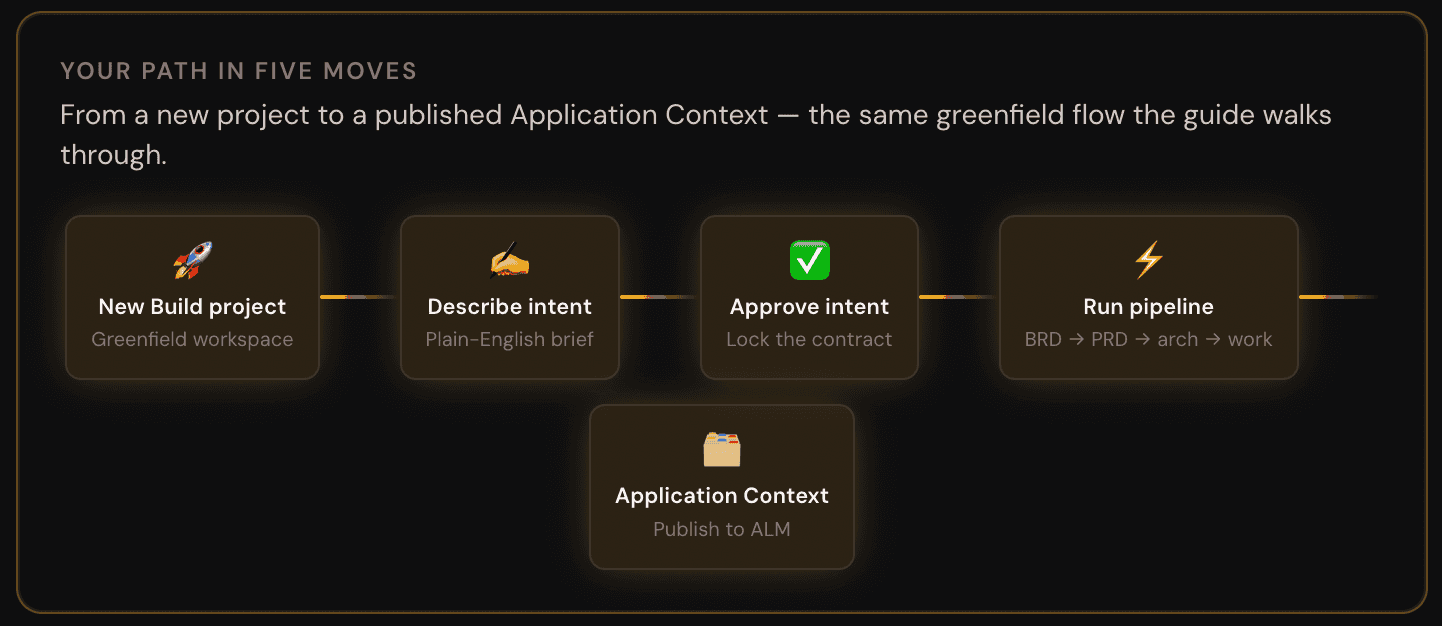
AI-SDLC changes the starting point. Inside Forge, teams begin with business intent. A product manager might provide a goal such as:
"Build a multi-tenant customer portal that allows enterprise administrators to manage users, permissions, billing access, and audit logs."
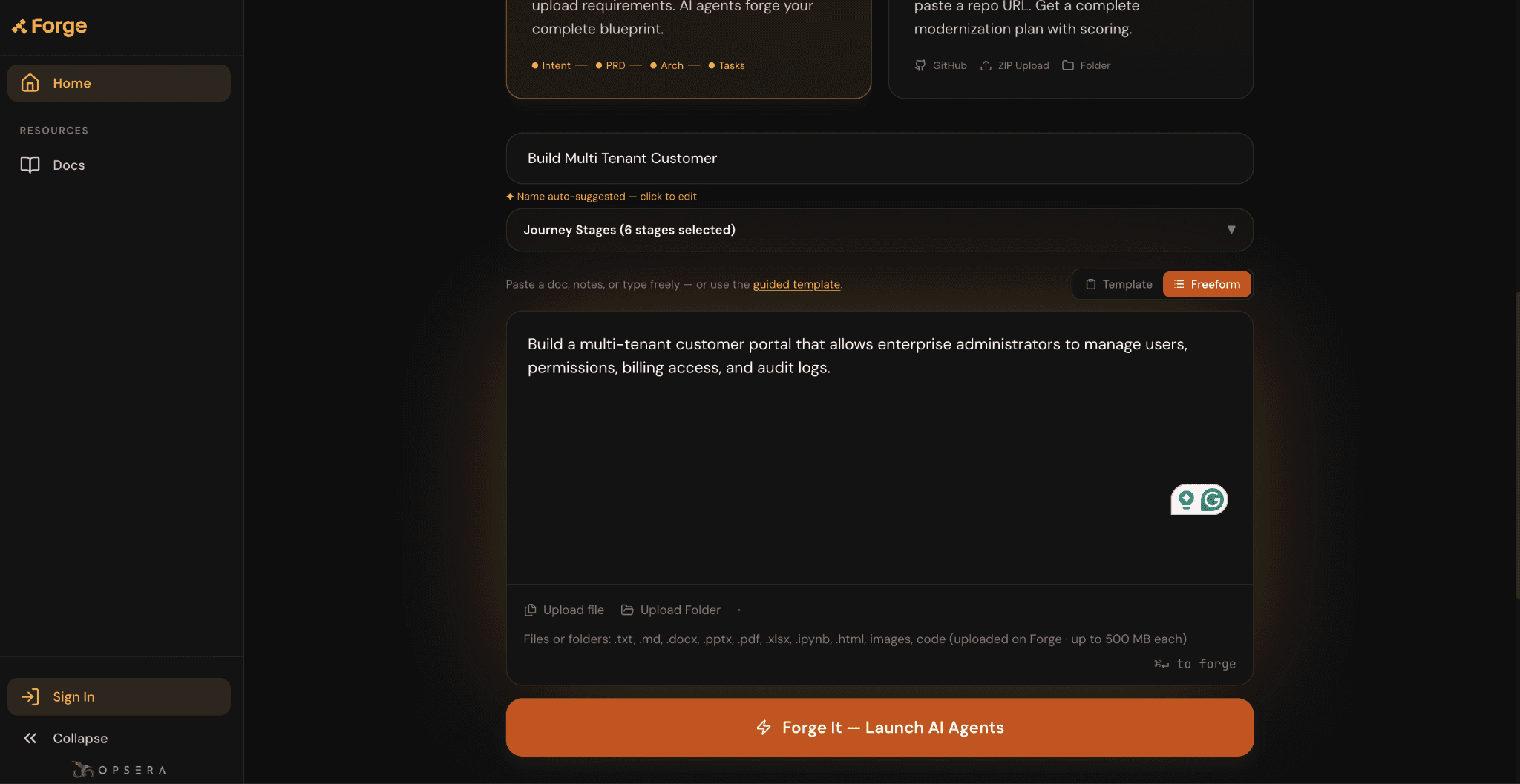
Rather than generating code immediately, Forge first parses the intent and produces a Living Specification. This becomes the system of record for the project.
The Living Specification captures:
Business objectives
Functional requirements
Non-functional requirements
Security obligations
Compliance constraints
Success metrics
Delivery scope
Out-of-scope boundaries
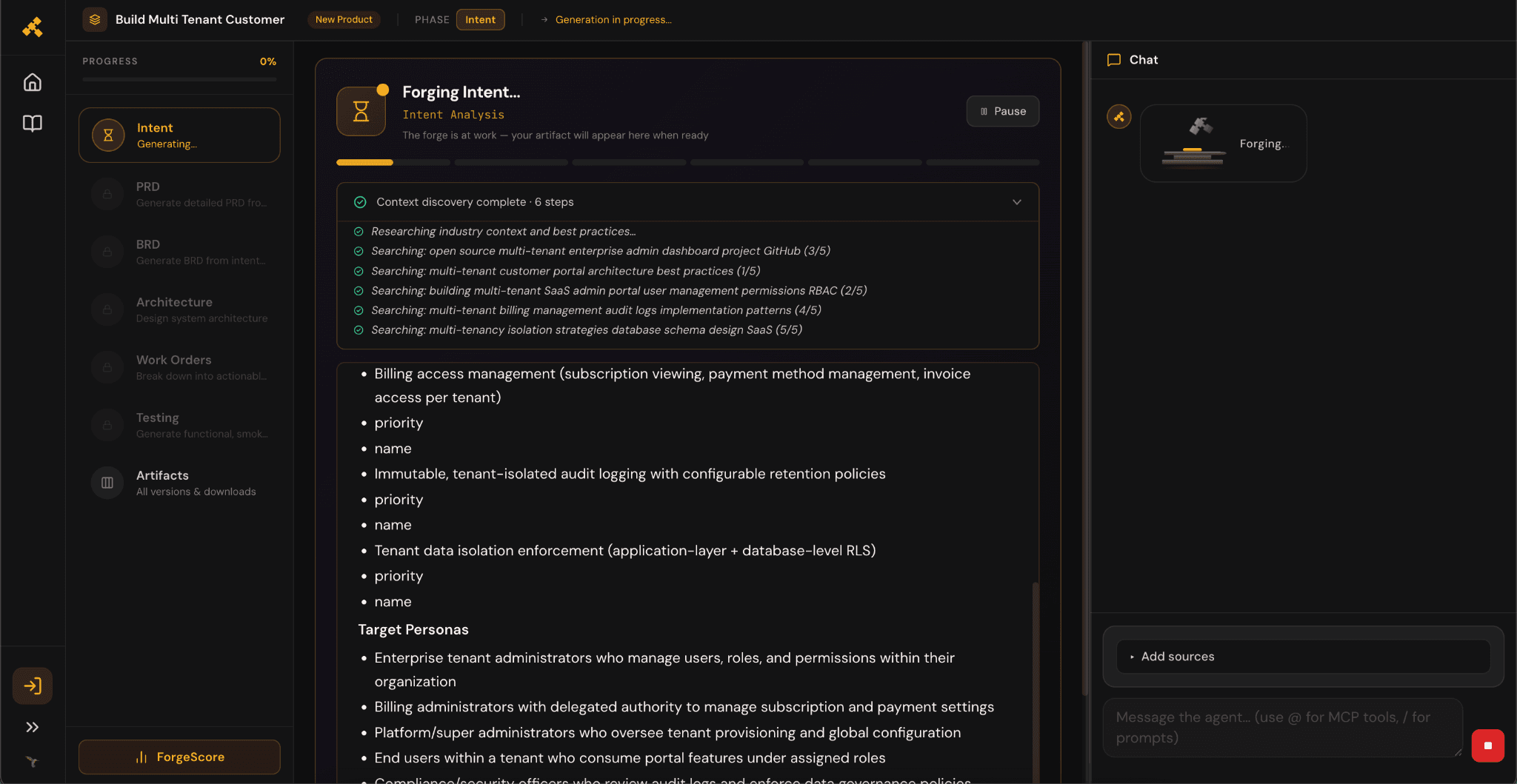
At this stage, stakeholders can review, refine, and approve requirements before technical implementation begins. The goal is to ensure that product intent is fully structured before architecture and delivery planning start.
This is the first major difference between traditional SDLC and AI-SDLC: ambiguity is resolved at the specification layer rather than surfacing later during implementation or testing.
How AI Handles Architecture And System Design
Once the Living Specification is approved, Forge generates architecture artifacts directly from the agreed requirements. Instead of architecture existing as a disconnected exercise performed in parallel with delivery planning, architecture becomes a traceable output of the approved specification.
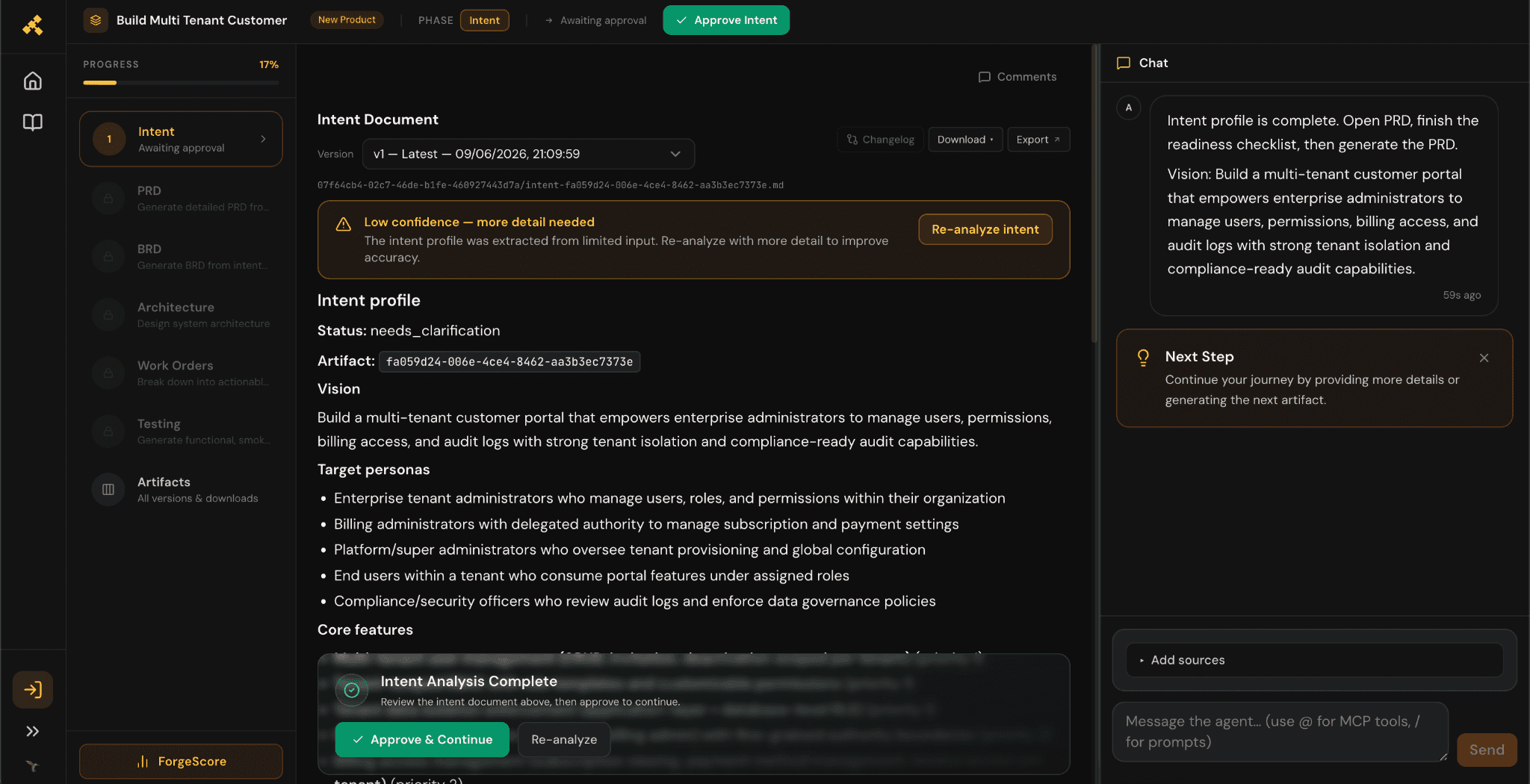
For a new build, Forge generates:
System architecture designs
Foundation blueprints
Feature blueprints
Technology stack recommendations
Security controls
Compliance mappings
Integration patterns
Deployment considerations
For project managers and engineering leaders, this provides something that traditional planning processes often lack: a direct connection between business requirements and implementation architecture.
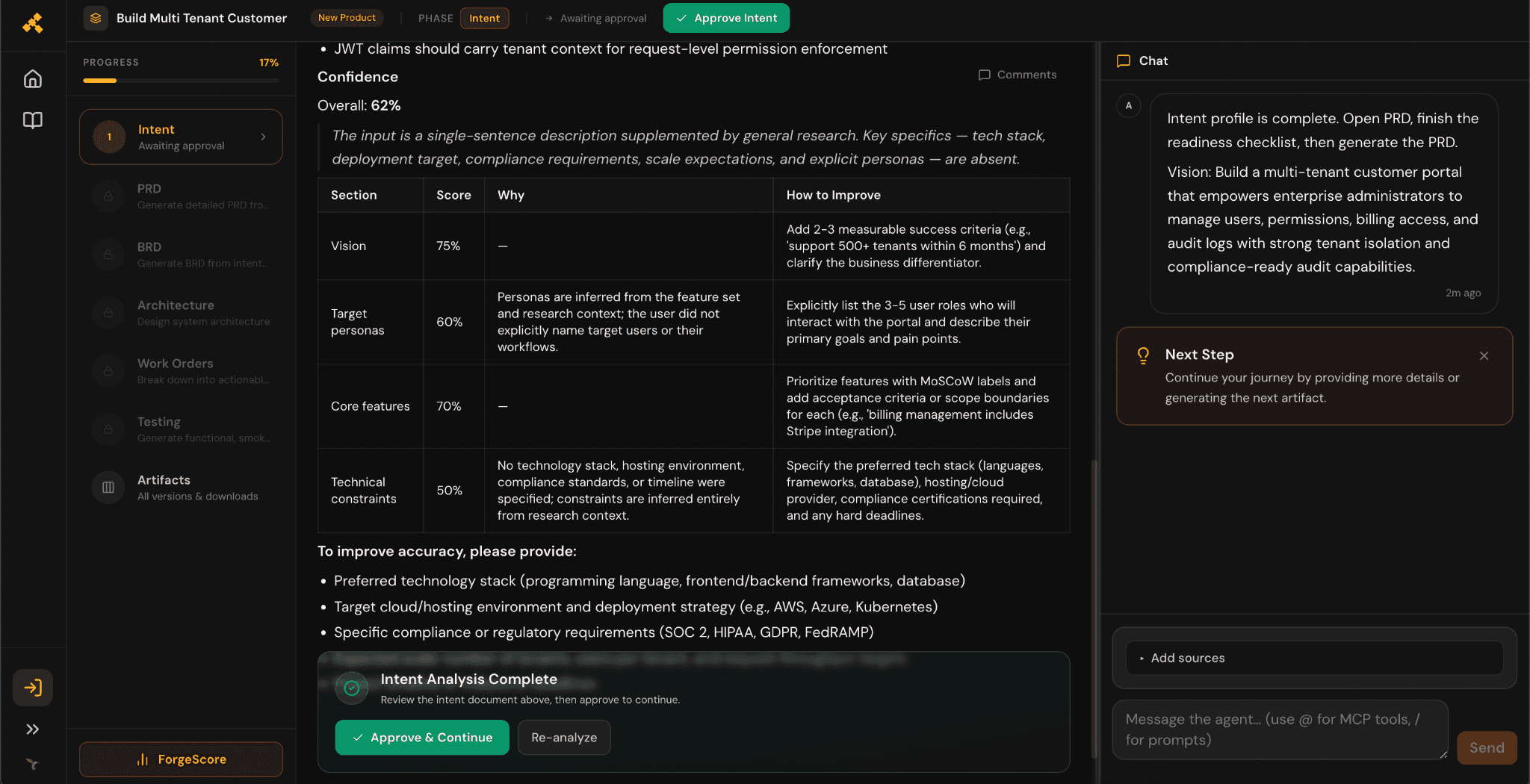
If a requirement changes, stakeholders can immediately identify which architectural components are affected. Architecture is no longer a static document stored in a repository. It becomes an active artifact connected to delivery planning and execution.
The result is that architecture reviews happen before development begins, reducing the rework that typically appears when implementation uncovers missing assumptions later in the project lifecycle.
How AI Converts Specifications Into Executable Work Orders
Once requirements and architecture are approved, Forge generates Work Orders. A Work Order is the execution unit within the AI-SDLC workflow. Unlike a traditional backlog ticket, a Work Order contains all of the context required to perform a specific implementation activity.
Each Work Order inherits information from:
The Living Specification, Architecture blueprints, Security requirements, Compliance obligations, Acceptance criteria, and Dependency relationships.
For example, a user management feature may generate a sequence of Work Orders covering:
Identity service implementation
Role management APIs
Permission enforcement
Administrative user interface
Audit logging
Security validation
Because each Work Order is generated from approved upstream artifacts, implementation remains aligned with the original business intent.
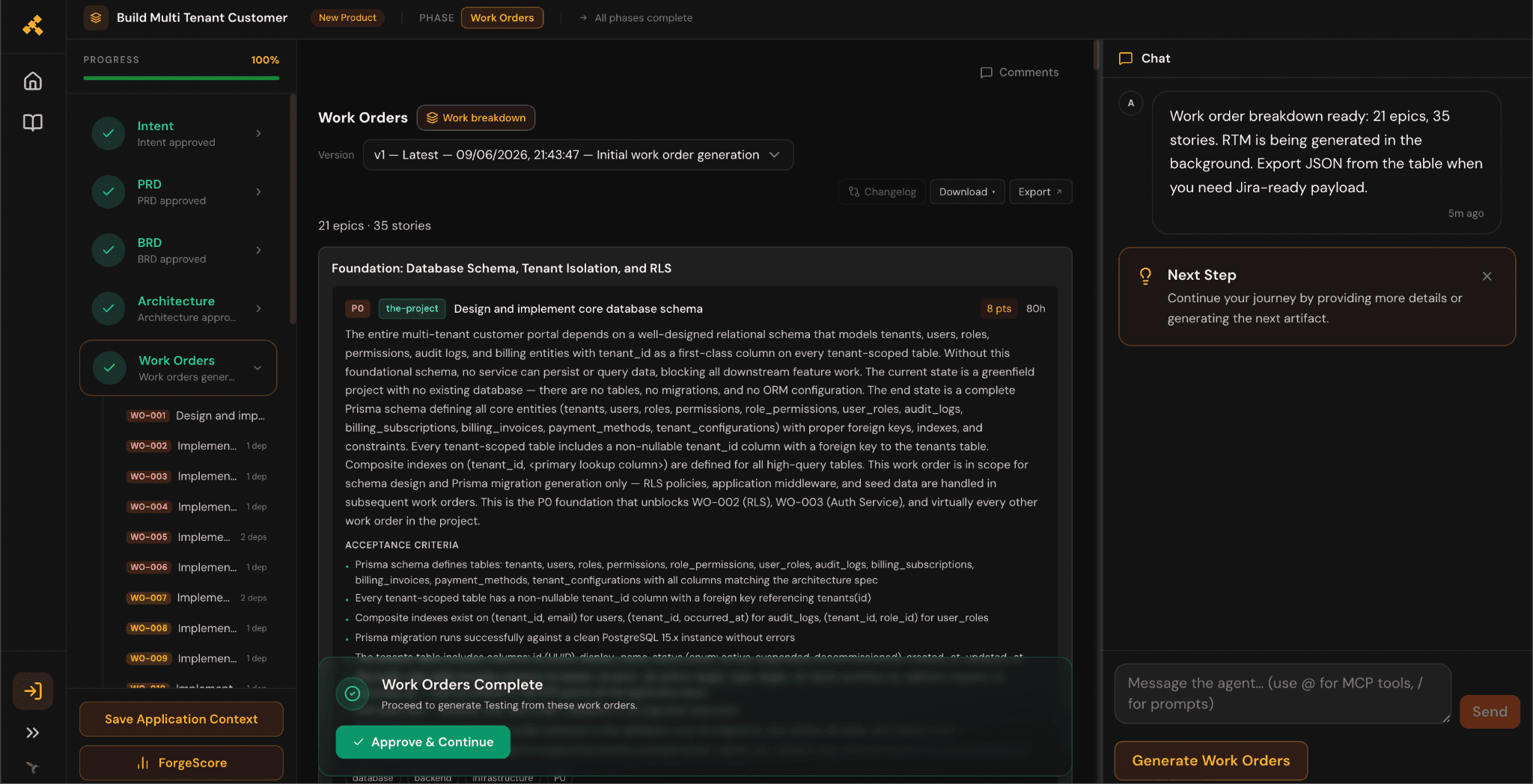
For delivery managers, this creates a significant operational advantage. Instead of tracking progress across disconnected requirements, architecture documents, and engineering tickets, every execution task maintains traceability back to the approved specification.
Forge describes this model as governed execution. Agent actions are authorized through human-auditable Work Orders, ensuring that delivery speed does not come at the expense of governance, compliance, or architectural consistency.
The outcome is not simply faster development. The outcome is a delivery process where requirements, architecture, and execution remain connected from the initial business objective through production deployment.
Understanding The Software Factory Model
A Software Factory isn't a new product category; it's an operational model with a defined lineage. Understanding the model makes the platform choices that implement it legible.
What A Software Factory Actually Is
A Software Factory treats software delivery as a structured, repeatable production process with consistent workflows, tooling, and artifact standards applied across every project. Rather than quality depending on which engineer is working on a given task, quality is a property of the process itself.
The concept predates AI; The DoD DevSecOps Playbook defines a software factory as a structured collection of related software assets that produces applications according to specific, externally defined requirements through an assembly process. The assembly framing is intentional: consistency of output comes from consistency of process, not heroics from individual contributors.
Structured Workflows Instead Of Ad Hoc Development
Standardized execution patterns replace project-by-project improvisation. Every piece of work moves through the same pipeline stages, uses the same tooling conventions, and produces artifacts in consistent formats. Teams working on their fifth project execute with the same discipline as teams working on their first because the workflow enforces it, not because everyone remembers the lessons from the previous four.
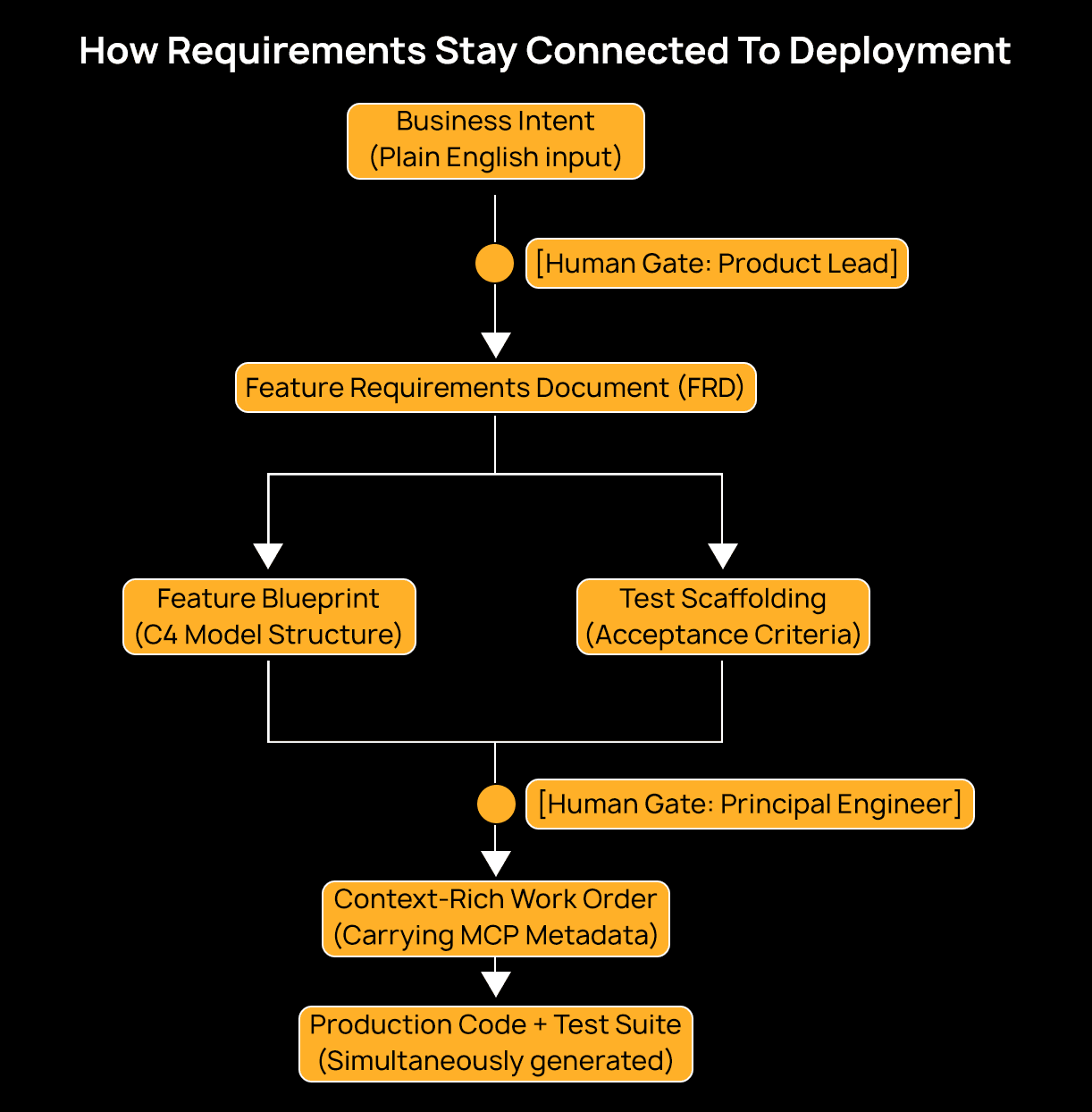
How Requirements Stay Connected To Deployment
Full traceability means every artifact from the initial business goal through to the merged commit links back to its origin. A security team reviewing a deployment can trace any changed code back to the requirement that drove it, the blueprint that governed its design, and the human who approved each transition:
Business Goal: "Reduce support tickets for permission issues" |
When something goes wrong, the on-call engineer has a clear decision trail, not a Slack archaeology project.
How Softwareforge Operationalizes AI-SDLC
Many AI development platforms enter the software lifecycle at the implementation stage. A developer opens an IDE, writes a prompt, and receives generated code. While this can accelerate individual tasks, it does little to address the problems that emerge earlier in the delivery process: unclear requirements, architectural drift, compliance gaps, fragmented documentation, and disconnected decision-making.
Softwareforge approaches AI-SDLC differently. Rather than treating AI as a coding assistant, it applies AI throughout the entire software delivery lifecycle, from business intent to governed execution. The platform is built around a Software Factory model where specifications, architecture, governance controls, and implementation plans remain connected throughout delivery.
At a high level, Softwareforge supports two distinct delivery paths.
The first is a greenfield workflow where teams start with a new product idea and progressively generate requirements, architecture, execution plans, and governed work orders.
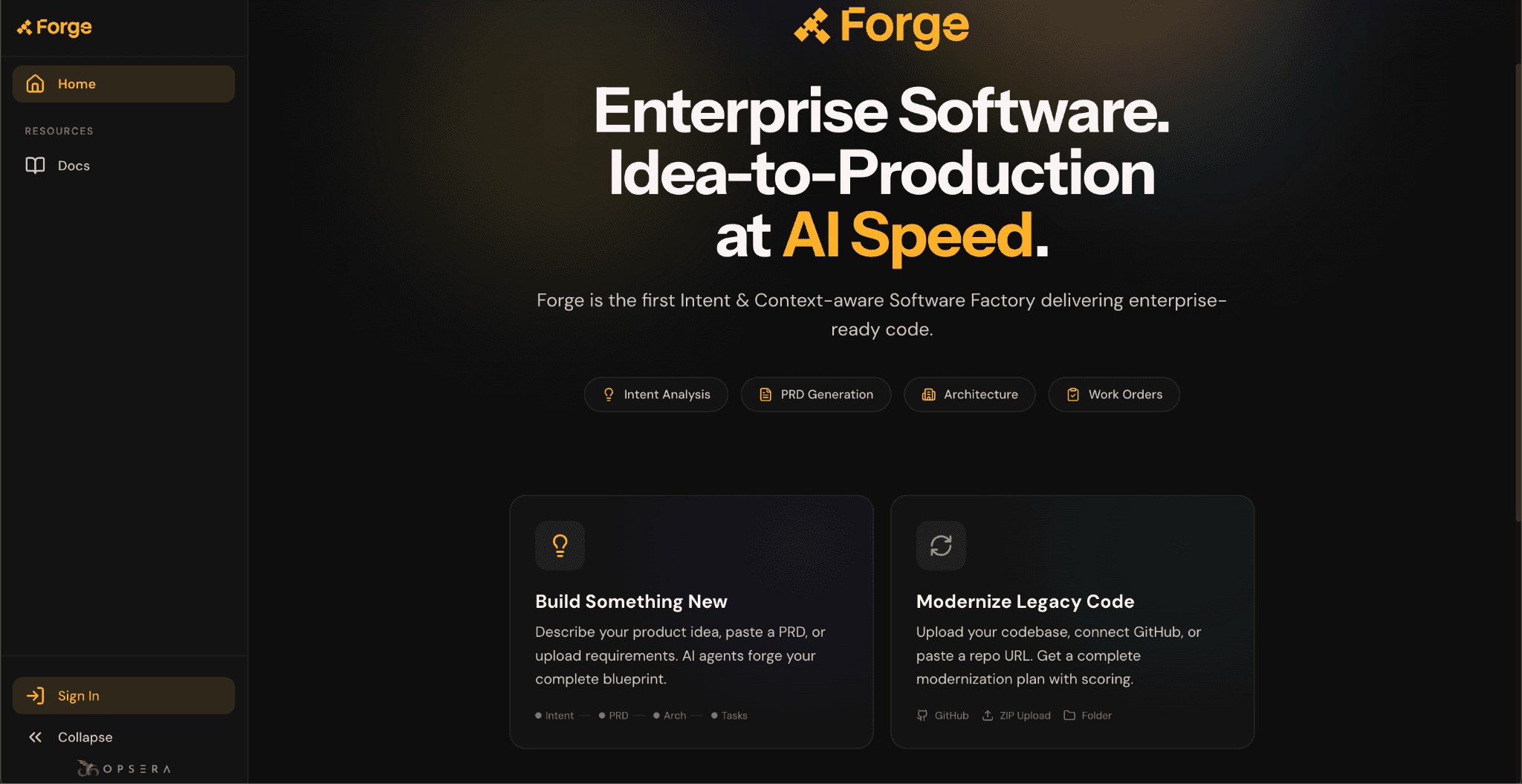
The second is a modernization workflow in which existing applications are assessed using ForgeScore before requirements and modernization plans are generated.
New Build Workflow: From Business Intent To Delivery
For a new application, teams begin by describing the business problem they want to solve. Rather than generating implementation artifacts immediately, Softwareforge first runs a structured discovery process that transforms business intent into a comprehensive engineering specification package.
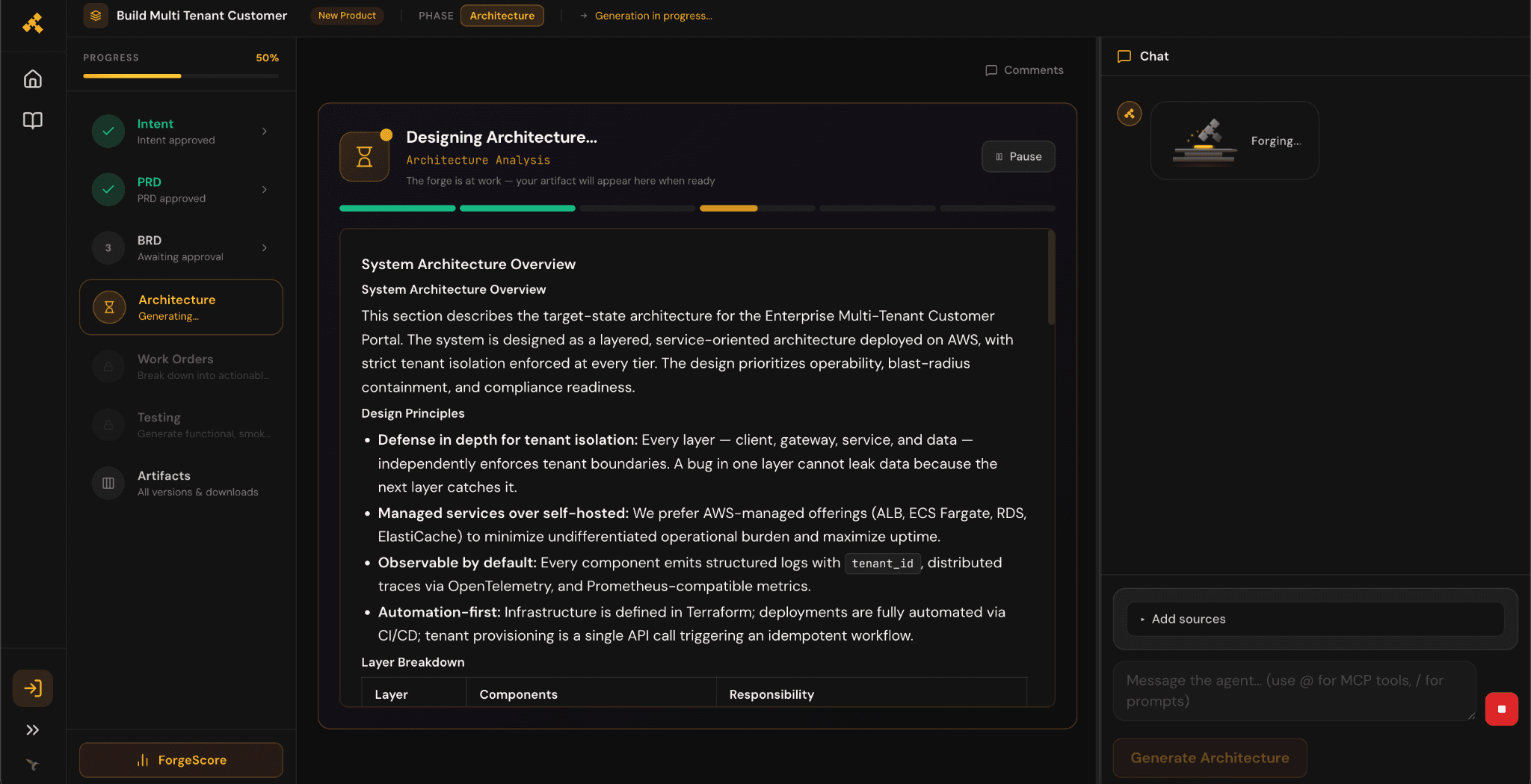
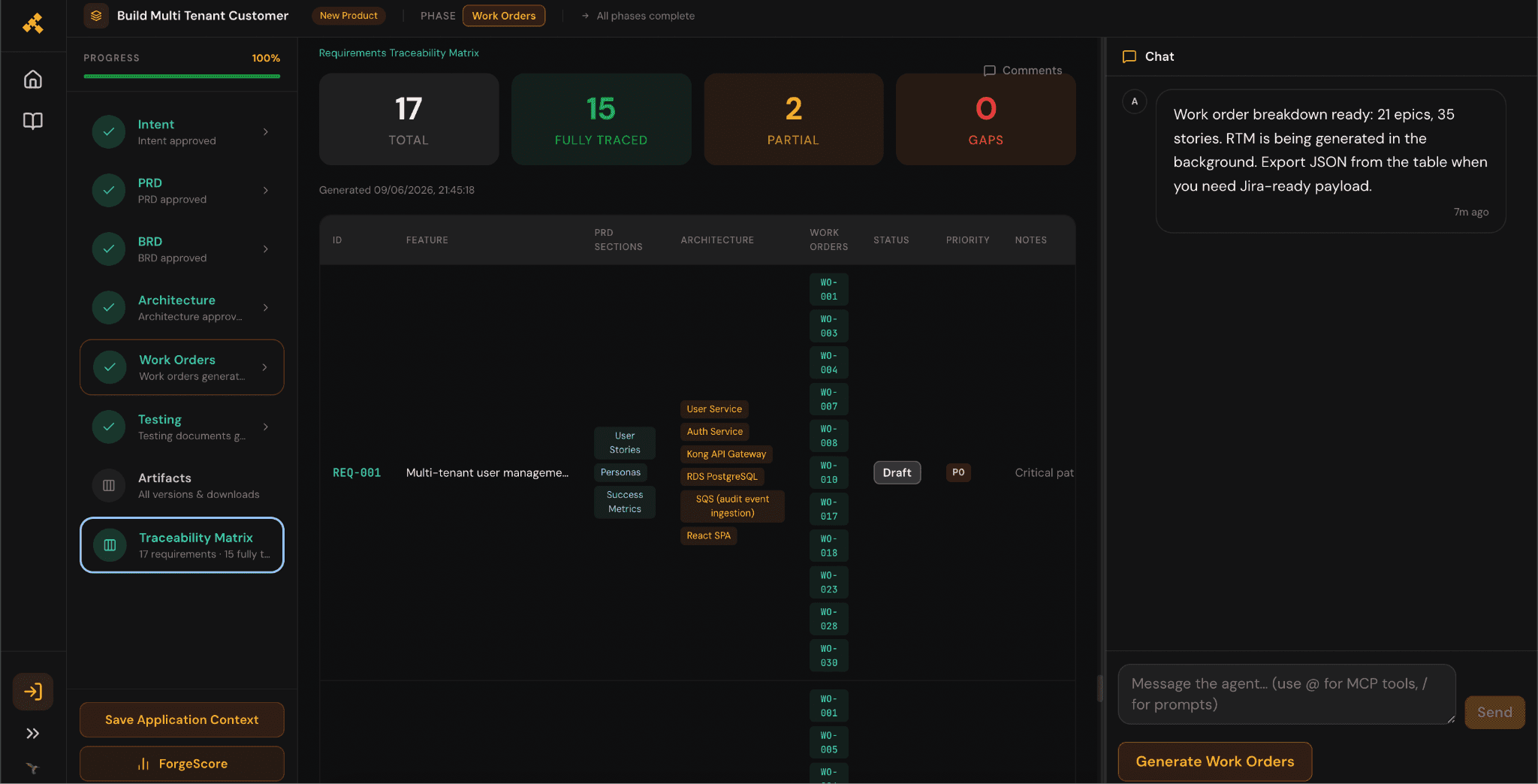
According to the New Build workflow documentation, the platform generates multiple interconnected artifacts, including:
Intent
PRD
BRD
Architecture Documents
Work Orders
Testing
Artifacts
Each artifact becomes an input into the next stage of the workflow rather than existing as an isolated document. This is an important distinction because traditional delivery processes frequently produce documentation that becomes disconnected as projects move into implementation.
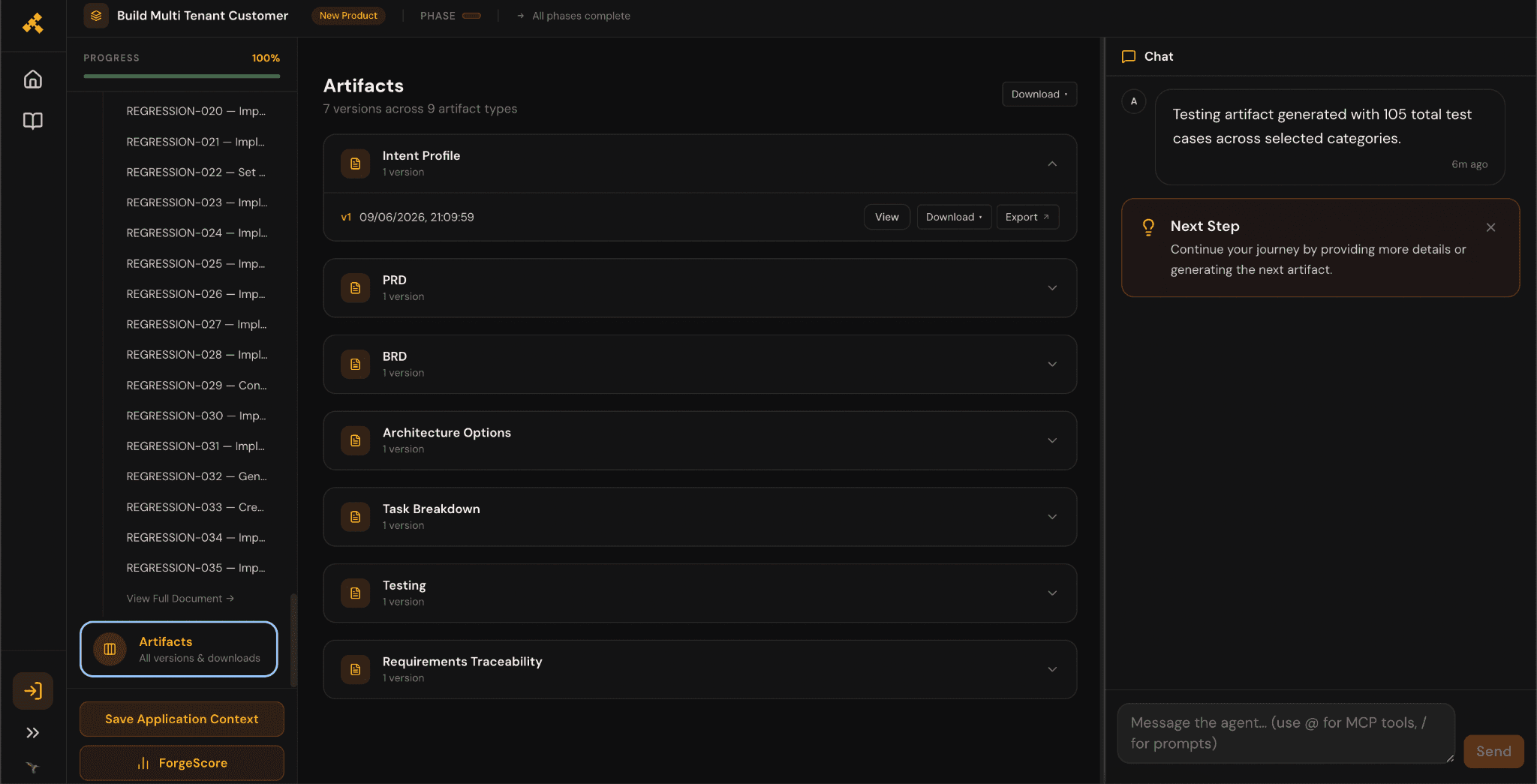
By maintaining relationships among these artifacts, Softwareforge creates what it calls a Living Specification, a continuously connected representation of the project's requirements, constraints, and delivery objectives.
ForgeScore: Establishing A Baseline For Modernization Projects
Most enterprise organizations are not building entirely new systems. They are modernizing applications that may have been operating for years, often with limited documentation and significant institutional complexity.
This is where ForgeScore enters the workflow. ForgeScore acts as the discovery and assessment layer for legacy modernization initiatives. Before generating migration plans or modernization recommendations, the platform evaluates the existing system and establishes a measurable engineering baseline.
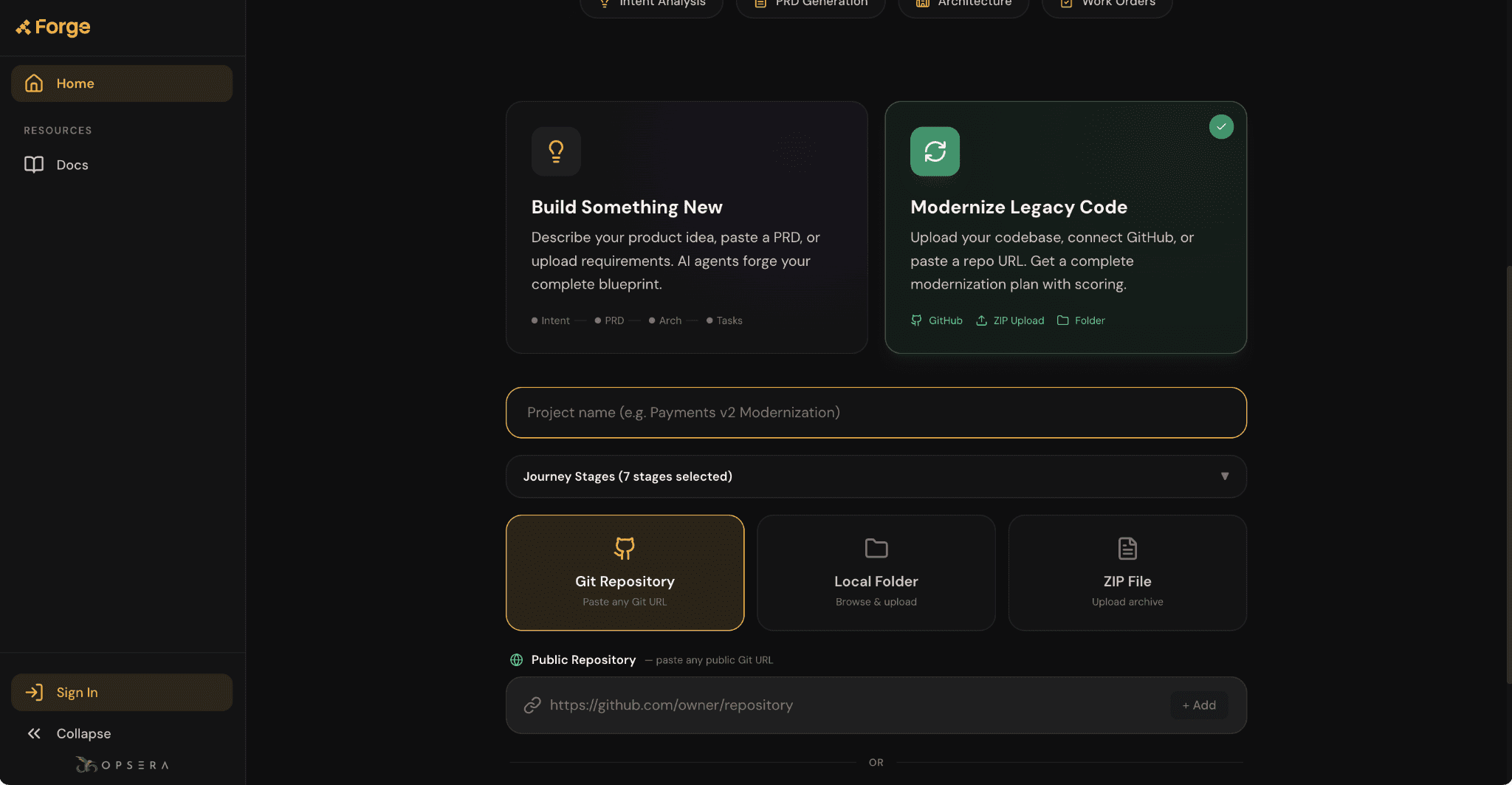
You give your github repository, give the project name, and just hit forge.
A ForgeScore assessment may surface findings such as Legacy framework dependencies, Security vulnerabilities, Compliance gaps, Architecture complexity, and technical debt accumulation, Test coverage limitations, API readiness, and AI adaptation opportunities.
For project managers and engineering leaders, this provides something that traditional modernization projects often lack: objective visibility into the system's current state before defining future-state requirements.
How Forge Translates Specifications Into Governed Work Orders
Work Orders in Forge are the execution unit that connects a Living Specification to a coding agent. Each Work Order is human-auditable and carries the intent, constraints, and acceptance criteria from the upstream specification, so agents receive structured context rather than isolated prompts. Forge authorizes all agentic actions through Work Orders before code reaches production, which is where the governance guarantee comes from.
Forge integrates with existing engineering tools, including Cursor, Claude, GitHub Copilot, and VS Code, so Work Orders are consumable directly inside the environments engineers already use. Belcorp's CDTO Venkat Gopalan described the outcome: "What once took weeks can now be achieved in minutes with an enterprise-grade modernization blueprint." The platform reports 66% rework eliminated and 83% faster delivery, with zero architectural drift, all traceable to the intent captured at the start of the pipeline.
The Core Components Of AI-SDLC Platforms
Three infrastructure layers make AI-SDLC work in production. Skipping any one of them produces a workflow that looks good in demos and breaks under real engineering load.
How Requirements Management Systems Capture Business Intent
Requirements management systems capture and organize business intent in a structured, queryable form with clear lineage from original goals through implementation. The keyword is queryable: coding agents encountering an edge case during implementation need to look up the constraint governing it, not guess. A static document in Confluence doesn't serve that need; a structured requirements layer with an agent interface does.
How Context And Knowledge Management Prevents Drift
Forge centers its platform on a persistent context layer that keeps Living Specifications, architectural plans, and implementation details connected so they evolve together. Forge describes this as eliminating "context rot," the failure mode where stateless agents lose alignment with the original intent as a build progresses. The persistent context layer carries system state through every agent handoff, so what the agent knows at Work Order five matches what was decided at the time of specification. Context engineering research confirms that most agent failures in production aren't model failures; they're context failures. The agent had the capability but lacked the information to use it correctly.
How Agent-Orchestrated Workflows Coordinate Development Stages
An orchestration layer coordinates agents across delivery stages, managing sequencing, dependencies, and handoffs without requiring constant human intervention. Forge runs intent analysis, requirements generation, architecture design, security and compliance mapping, and Work Order creation as a connected pipeline rather than as isolated steps handed off between tools. Persistent context carries the Living Specification through every stage, so agents at each handoff work from the same locked intent rather than starting from a stripped-down prompt.
Stateless agents cause context rot, as Forge states it directly, and the persistent context layer is specifically what prevents downstream agents from drifting from decisions made earlier in the pipeline. Humans stay in the decision loop through human-auditable Work Orders, which authorize each agentic action before execution; agents handle the sequencing and synchronization work in between.
Benefits And Limitations Of AI-SDLC
Worth stating plainly: AI-SDLC is a complexity-management strategy, not a complexity-reduction strategy. The workflow has more moving parts than a traditional SDLC. The tradeoff is that those parts are consistent, observable, and correctable.
Where Engineering Teams Gain Measurable Efficiency
Requirement analysis gets faster when agents handle the first draft, and humans handle review and clarification. Documentation stays current because it's generated from the same artifacts that drive development, rather than being written separately afterward. Development throughput increases as repetitive tasks, writing boilerplate, generating test scaffolding, and formatting API specs, get handled by agents that don't need context-switching time. The Gartner figure is worth repeating: 25–30% productivity improvement across the full SDLC versus 10% limited to code generation.
What Challenges Organizations Must Prepare To Address
AI-generated outputs require active quality management. An agent that receives a poorly structured work order produces poorly structured code. Garbage in, garbage out applies as much to AI workflows as to any other process. Context management across long workflows adds operational complexity, and Gartner projects that over 40% of agentic AI projects will be canceled by the end of 2027, primarily due to escalating costs, unclear ROI, or inadequate risk controls. The organizations that survive that attrition rate will be the ones treating agent workflows as engineering infrastructure, not as a feature they can toggle on.
Which Roles Still Require Experienced Human Judgment
Architecture decisions, risk assessment, and business prioritization still require human expertise, not because current models lack capability in isolation, but because they lack accountability. The decision about which technical constraints govern a system, how risk tolerances translate into implementation choices, and what to build next, given competing business pressures, all require someone who can be held responsible for the outcome.
Forge's design acknowledges this directly: the platform positions engineering authority as something that stays with the team, not something delegated to agents. As Forge states, AI speed plus your engineering authority is the operating model: agents govern velocity through guardrails and persistent context, while humans retain control over the decisions that define what gets built and why.
Where Organizations Are Adopting AI-SDLC
Adoption clusters around three types of engineering problems: legacy complexity, regulatory pressure, and coordination overhead at scale.
How AI-SDLC Accelerates Enterprise Application Modernization
Large enterprises use AI-SDLC to modernize legacy systems without discarding the institutional knowledge embedded in them. Agents can parse legacy codebases, generate structured documentation of current behavior, and produce requirements for equivalent modern implementations, work that would otherwise require months of manual analysis. Forge supports both greenfield builds and legacy modernization.
For brownfield work, ForgeScore recovers the logic, architecture, and intent buried inside legacy systems, turning institutional context into a usable modernization asset. As one Fortune 100 technology executive noted, Forge turns legacy software from a 'black box' into a usable enterprise asset by restoring the context around how it works.
Why Regulated Industries Are Adopting AI-SDLC First
Financial services organizations use structured workflows to maintain auditability across every change touching customer data or risk calculations. Life sciences organizations face equivalent pressures: clinical trial software, laboratory information systems, and regulatory submission tools all require documented evidence of how requirements were defined, implemented, tested, and approved. Forge is built with these constraints as design requirements, not afterthoughts.
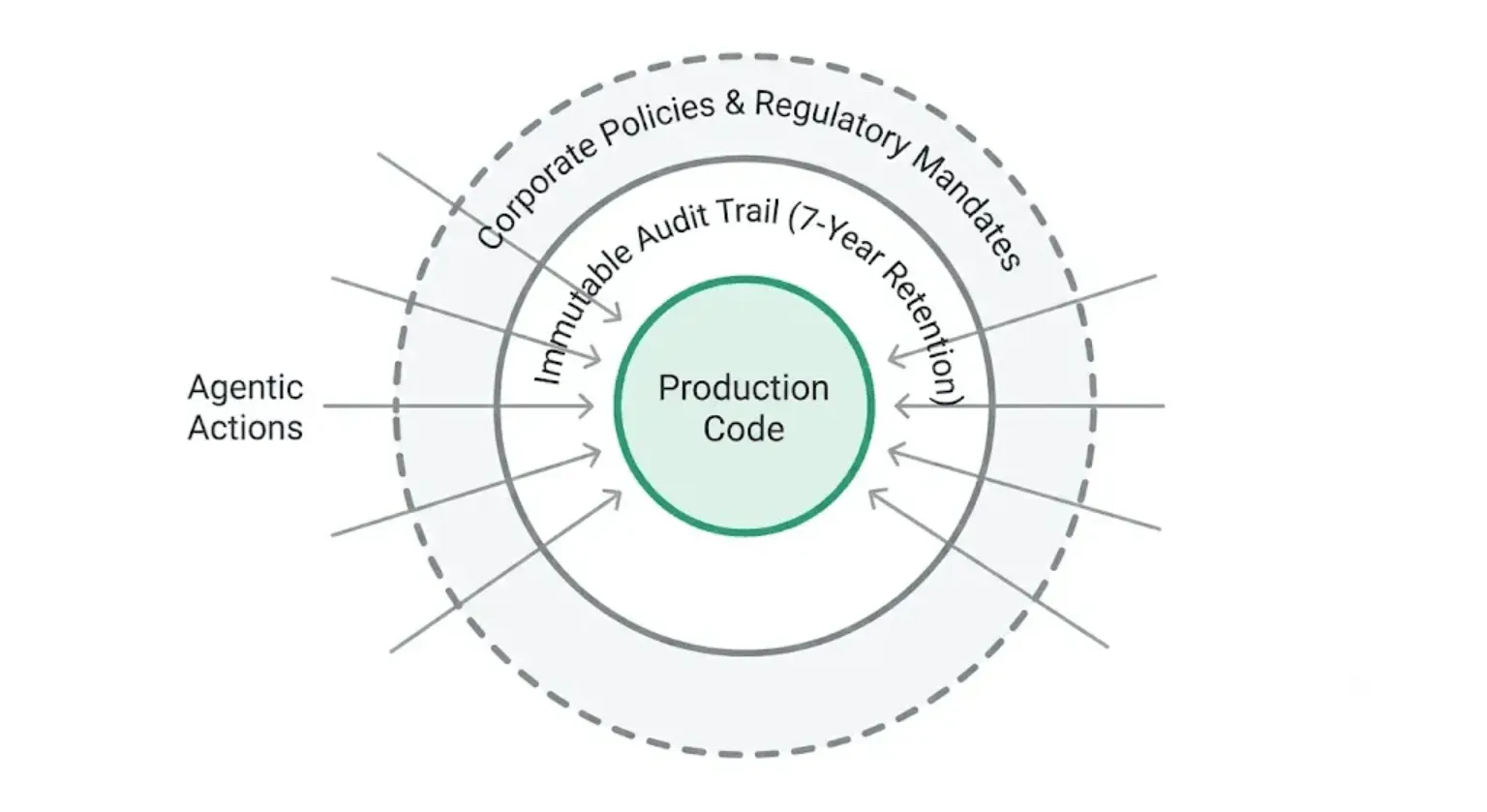
The platform structurally maps every agentic action to corporate policies and regulatory mandates, maintains an immutable audit trail retained for seven years,
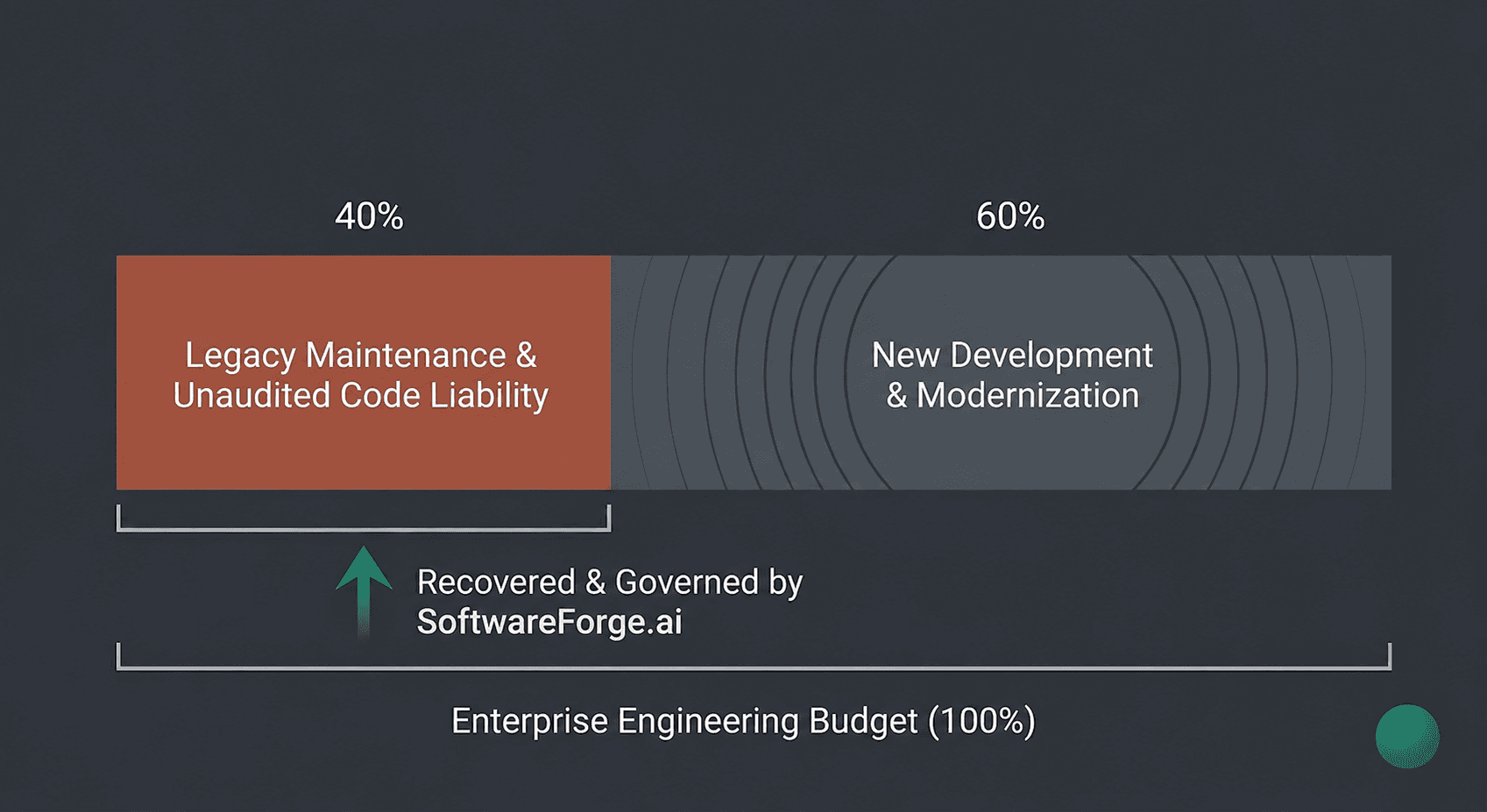
and ensures code is auditable and compliant before it reaches production. Enterprises are spending nearly 40% of their budgets on legacy software maintenance, and more unaudited code increases that liability, making governed AI delivery a financial argument as much as a compliance one.
How Large Engineering Organizations Coordinate At Scale
Multi-team organizations use AI-SDLC to prevent the coordination failures that scale creates. When ten teams build components that need to integrate, the shared Living Specification and persistent context layer make the difference between integration tests that pass and a release week that consumes two unplanned sprints.
Forge eliminates architectural drift entirely by anchoring every agent and every team to the same locked intent throughout the build cycle. Without a shared specification, the architecture drifts at ungoverned speed, which Forge identifies as one of the three core failure modes of traditional AI-assisted development. When the specification is authoritative and persistent, teams stop spending energy debating what the system should look like and spend it building.
Why AI-SDLC Is Ultimately A Context And Governance Problem
AI-SDLC shifts AI participation from a productivity feature within the IDE to a structural layer that spans the entire delivery process. Requirements analysis, architecture design, work order creation, code generation, test coverage, and governance checks become orchestrated activities with shared context, traceable outputs, and enforced review gates at each stage. The Software Factory model provides the operational structure that makes those activities repeatable across teams and projects: standardized workflows, a persistent knowledge graph, and policy enforcement baked into sequencing rather than bolted on afterward.
The organizations building on this model, particularly in regulated industries where auditability is non-negotiable, aren't adopting it because the technology is interesting. They're adopting it because the alternative, scaling human coordination linearly to match the complexity of modern software systems, has a ceiling most large engineering organizations have already hit.
FAQs
What Is AI-SDLC In Software Development?
AI-SDLC is a delivery workflow in which AI agents participate in structured activities at every phase, from requirements parsing through deployment, rather than acting only as code-completion tools. Agents receive structured context, including requirements, blueprints, and constraints, and produce traceable outputs at each stage that feed the next.
How Does AI-SDLC Differ From Traditional SDLC?
Traditional SDLC relies on human engineers to produce and maintain artifacts at every phase, with AI optionally assisting at the code-writing step. AI-SDLC builds agent participation into the workflow structure itself, with shared context layers, automated handoffs between stages, and governance gates enforced by the platform rather than by individual process discipline.
What Is A Software Factory In AI-SDLC?
A Software Factory is an engineering model that treats software delivery as a structured, repeatable production process with standardized workflows, tooling, and artifact formats applied consistently across all projects. In an AI-SDLC context, it coordinates agents, manages shared context, and enforces governance so delivery quality isn't dependent on individual contributor discipline.
Why Is Governance Important In AI-Assisted Software Development?
Agents produce outputs based on the context they receive. Without enforced review gates, policy checks, and audit trails, errors in context propagate through the workflow and reach production unchecked. Governance in AI-SDLC is a workflow property built into stage sequencing, not a manual review added at the end after the damage is done.


