SoftwareForge vs Blitzy
SoftwareForge is the governed AI-SDLC
Blitzy is an AI-Native code generation platform
SoftwareForge carries intent and compliance from idea to production. Blitzy ingests your codebase, plans an Agent Action Plan, then generates and validates code. Here's how they compare.

Trusted by engineering teams building at scale

REVINCI




Two governed approaches to
AI-driven delivery
SoftwareForge governs the enterprise SDLC end to end. Blitzy is a code-generation platform for tickets, epics, or a blank prompt.
Living Specifications, not scattered docs
Specs and architecture travel with the codebase across every session. Blitzy's Technical Spec also persists, but feeds a single Agent Action Plan, not a governed BRD/PRD/Architecture pipeline.
90%
80%
Human-auditable Work Orders
Nothing ships without a human sign-off, logged every time. Blitzy gates at AAP and PR review, scoped to one generation task, not a persistent Work Order.
Runtime-validated code generation
Forge's Security Agents review every artifact at generation time for OWASP gaps and secrets. Blitzy's Runtime Validation compiles and tests code before opening a PR.
Legacy modernization without losing the plot
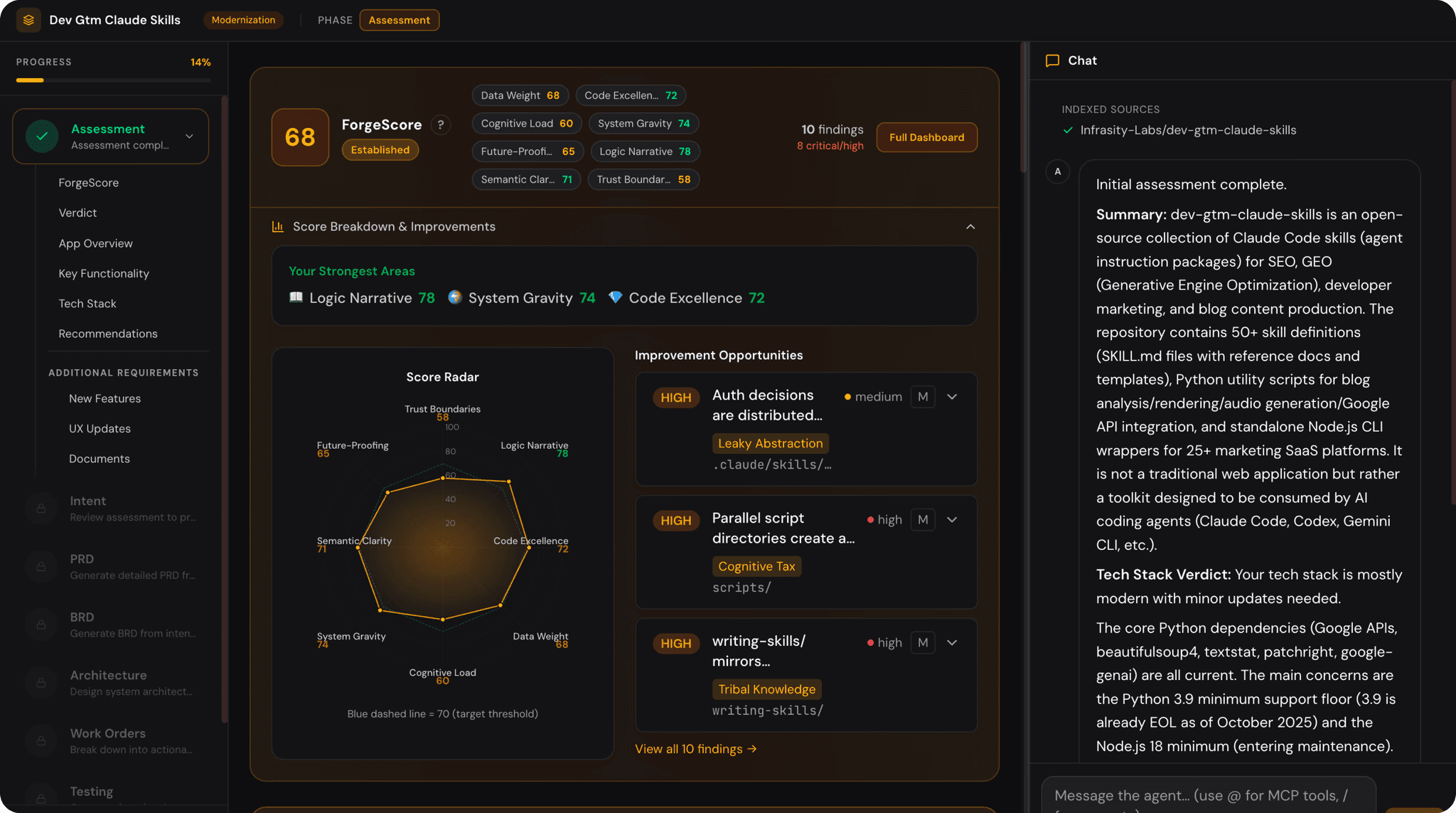
ForgeScore gives a 0-100 health check across 8 dimensions before a rewrite. Blitzy documents architecture in a Technical Spec, with no comparable score.
Two governed platforms
Different entry points,
different strengths
This isn't a comparison on the same axis. SoftwareForge governs the enterprise SDLC; Blitzy is a code-generation platform for tickets, epics, or a blank prompt.

SoftwareForge governs the entire AI-SDLC from spec to production, using the tools your team already runs. Idea to production in hours, not months.
Living Specifications keep PRDs, architecture, and work orders in one versioned system
Human-auditable Work Orders document every agentic action
Integrates directly with Jira, GitHub, Slack, and CI, no stack replacement
ForgeScore assesses legacy codebase health across 8 dimensions for modernization
Generates a governed spec in minutes via a spec-first, agent-guarded pipeline

Blitzy ingests your repo, plans an Agent Action Plan, then generates and validates code before opening a PR.
Agent Action Plan (AAP) reviewed and approved before any code is generated
Technical Specification persists per repository and updates as code changes
Runtime Validation compiles, runs, and tests generated code before opening a PR
Connects to GitHub, GitLab, Bitbucket, and Azure DevOps; SAML-based enterprise SSO
Usage-based billing by lines of code; Free and Enterprise plans

Beyond the Basics
Where SoftwareForge
goes further
SoftwareForge goes further with governed, persistent delivery, not planning scoped to one generation task.

Work Orders & Delivery Tracking
Work Orders vs Blitzy's AAP review
SoftwareForge turns intent into governed work orders tied to architecture. Blitzy's AAP is reviewed per generation, with no persistent, cross-session backlog.
Legacy Modernization
Legacy modernization vs Blitzy's codebase ingestion
ForgeScore scores modernization risk across 8 dimensions before the rewrite. Blitzy documents architecture, with no comparable score for your repo.

GOVERNANCE & COMPLIANCE
Compliance policy engine vs Blitzy's prompted workflows
Security Agents review every artifact at generation time for OWASP gaps, secrets, and prompt injection, backed by compliance presets. Blitzy validates through its own 3-layer review (AAP, Dynamic Validation, Code-Level Review) plus your SAST/DAST tooling.
At a Glance
Full capability
comparison
Six dimensions where SoftwareForge and Blitzy actually differ.
Capability
Intent: Living Specification (PRD / BRD / FRD)
Auto-generated Living Spec, versioned across the whole SDLC. Blitzy generates a fresh AAP per prompt; its Tech Spec persists per repo.
AAP is per-prompt, not a governed pipeline
Governed BRD/PRD/Architecture pipeline
Human-Auditable Work Orders
Every action is authorized by a human via Work Orders, tracked in Application Context. Blitzy gates at AAP and PR review, scoped to one task.
Human-in-the-loop by design
AAP + PR gate, scoped to one task
Compliance Policy Engine
Industry-preset policies (HIPAA, PCI-DSS) injected directly into generation. Blitzy supports compliance-readiness as a prompted, manually-mapped workflow.
Prompted workflow, manually mapped
No standing policy engine
Security Agents (Generation-Time Review)
Security Agents review every artifact for OWASP gaps, secrets, and prompt injection at generation. Blitzy's 3-layer review (AAP, Dynamic Validation, Code-Level Review) gates at PR, using your SAST/DAST tooling.
Built into the pipeline
3-layer review: AAP, Dynamic Validation, PR
ForgeScore — 8-Dimension Health Check
Composite score (0-100) across 8 health dimensions, with maturity label and findings. Blitzy documents architecture, no comparable score.
Full scorecard with maturity label
No codebase health scoring
AI-SDLC Framework
Governed system spanning intent, specs, architecture, work orders, and compliance. Blitzy is a code-generation platform for tickets, epics, or a blank prompt.
Full governed lifecycle
Code-generation platform, not an SDLC layer
Data Privacy — No Model Training
Your code and data stay private to your workspace, never used to train foundational models. See Blitzy's own privacy policy for their terms.
Private by design
See Blitzy's privacy policy
What SoftwareForge adds that Blitzy doesn't have
The governed SDLC layer
a code-gen platform doesn't give you
Blitzy is a capable code-generation platform, scoped to a generation task, not a governed system of record. SoftwareForge adds the spec, audit, and compliance layer around it.
Security Agents
Every artifact reviewed at generation time for OWASP gaps, secrets, and prompt injection. Blitzy reviews at the AAP and PR stages, using your own scanners.
Role-based governance
Six personas, each scoped across every artifact type. Blitzy's three roles (Super Admin, Admin, Member) govern team access, not per-artifact approval.
Compliance policy engine
Industry presets for HIPAA, PCI-DSS, and more, injected directly into generation. Blitzy supports compliance-readiness as a prompted, manually-mapped workflow.
Native tool integrations
GitHub, Jira, Slack, and CI, plus a built-in MCP server. Blitzy connects to GitHub, GitLab, Bitbucket, and Azure DevOps.
Highlights
What changes when you govern delivery with
SoftwareForge
8
Codebase Health Score
delivered by ForgeScore. Blitzy has no equivalent.
Hours
Idea to Production
via SoftwareForge's spec-first, agent-guarded pipeline for enterprise
Living
Specification
Forge's spec travels across the entire SDLC, not one generation session
Zero
Stack Replacement
SoftwareForge governs the same IDE, Git, and CI tools your team already runs
FAQs
What is Forge?
How fast can we go from Idea-to-Production?
What is an AI-SDLC?
What is ForgeScore?
How does Forge handle security and compliance?
Does Forge use my data to train AI models?
Can Forge work with my existing tools?
How is SoftwareForge different from Blitzy?