Industry solution for healthcare and health-tech
Healthcare Application Modernization
The clinical logic in a legacy EHR is usually the part worth keeping. The platform underneath it is the problem. Modernization means decoupling the two, not rewriting both at once.
Six reasons health systems modernize off legacy platforms
The pressure is rarely that the software stopped working. It is that the people who can safely change it are disappearing while the compliance deadlines are not.
The talent pool is the real deadline
MUMPS and Delphi both carry very small and shrinking developer communities. Every year the estate stays as it is, the pool of people who can change it safely gets smaller and the key-person risk concentrates further.
Clinicians are locked to one platform
A Windows-only desktop client means clinicians on Mac, Linux, or tablets need workarounds to do their jobs. A browser-based client removes the workaround rather than documenting it.
BEHAVIOR PRESERVED
Interoperability deadlines carry penalties
FHIR R4 certification is a compliance requirement with real financial exposure, not a roadmap item. Systems with no FHIR code path at all need that work scoped honestly rather than assumed.
No pipeline means no safety net
Estates with no CI/CD rely on manual test execution, so every change is a judgement call. Automated validation on each pull request is what makes incremental modernization survivable.
Supply chain risk is invisible
Dependencies without automated auditing or a committed lockfile can carry known CVEs that nobody has looked for. Scanning in the build is the difference between knowing and hoping.
Clinical logic is the asset
Decades of encoded clinical rules are why the system is trusted. Modernization should preserve that logic and replace the platform around it, which is exactly what a rewrite risks losing.
See your ForgeScore before you commit
Every import is scored across eight engineering-health dimensions before a Work Order is planned, so you know what you are dealing with up front.


Health systems running homegrown claims engines, MUMPS-era EHRs, and point-to-point integrations do not fit the modernization playbooks written for SAP estates. Forge imports the codebase as it is, scores it, and reconstructs the clinical rules into a specification before any replacement is planned.
8
ForgeScore dimensions
Every stage
Approval gates
6
Pipeline stages
What changes when you modernize incrementally
The shift is more than syntax. Paradigms, data access, and runtime assumptions all move, and each one needs an explicit mapping.
01
An API layer in front of the core
REST, GraphQL, and FHIR endpoints wrap the existing core so modern clients can reach clinical logic without that logic being rewritten. New features get built against the API in mainstream languages instead of the legacy one.
02
The client migrates behind feature flags
A Strangler Fig pattern keeps the legacy desktop client and the new web client running side by side against the same data, with feature flags controlling which workflows route where and clinical review gating each cutover.
03
Authentication moves to modern standards
OAuth2 and SMART on FHIR for external clients, mTLS between the API layer and each site, and a credential vault mapping modern identities onto legacy access codes, with every call logged.
04
Deployment becomes reproducible
Containerized test environments and pipeline validation on every pull request replace manual test runs, so changes to a system serving live clinical workflows can be verified before they land.


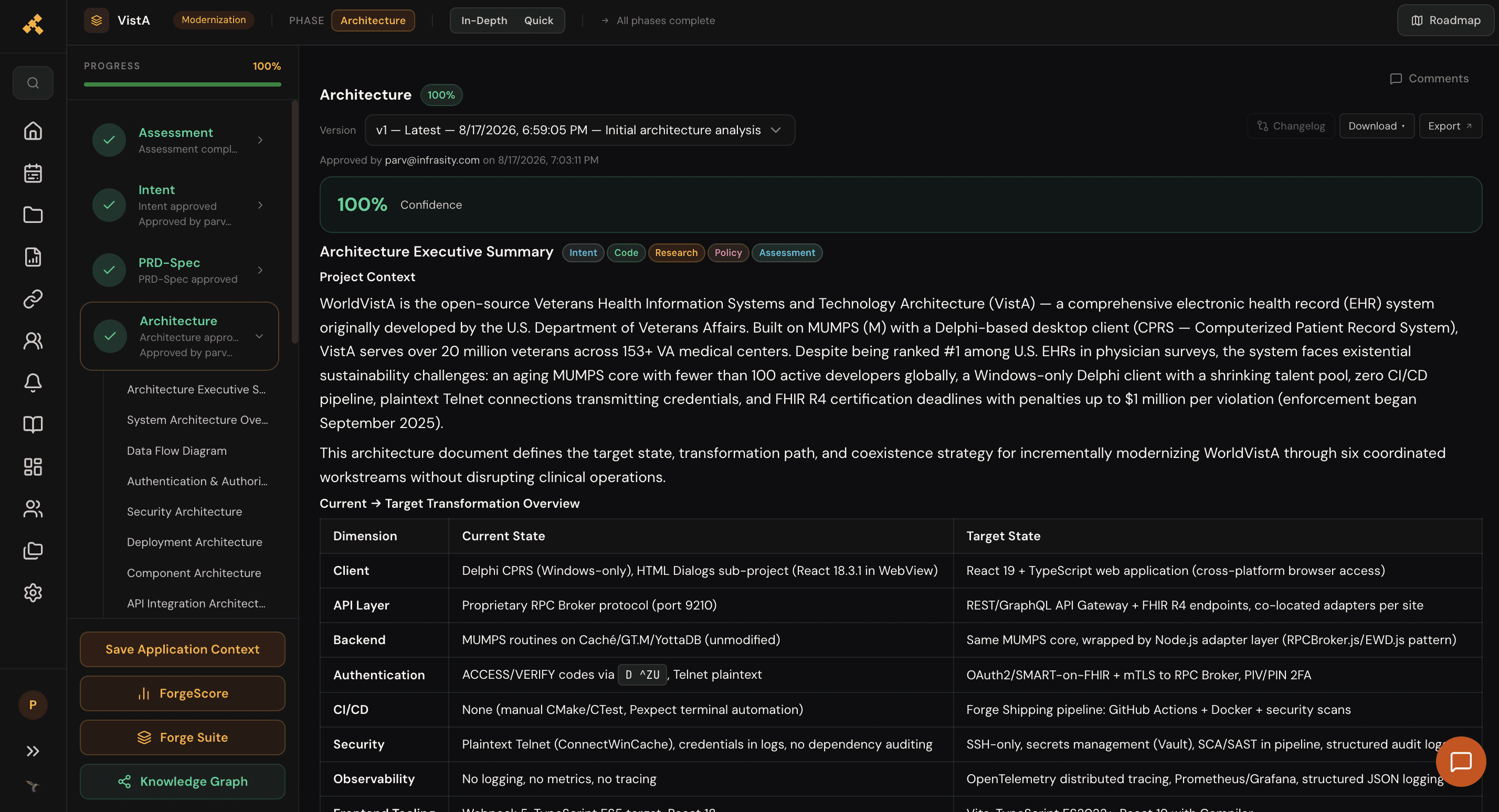


What Forge actually produces
Every import is scored across eight engineering-health dimensions, then broken into dependency-ordered work orders. Here is what the first one looks like.
Assessment finding
Trust Boundaries
High
Security and dependency auditing. No evidence of automated scanning tooling in the repository, and a JavaScript sub-project carrying runtime dependencies without lockfile evidence.
High severity finding
Modernization work order
WO-001 · Pull request validation pipeline
Build
Stand up automated validation on every pull request as the foundation the rest of the modernization depends on. Critical and high severity dependency vulnerabilities block merge, with audit results posted back as review comments. Unblocks the containerized test environment and the audit stages that follow it.
Common challenges
Forge surfaces the decisions a healthcare modernization tends to defer. These came out of the approved specification as open questions rather than surprises mid-migration.
Clinical safety gates every cutover
Routing a workflow from the legacy client to the new one is a clinical decision, not just a deployment. Who reviews and approves each cutover has to be settled before the first flag is flipped.
Multi-site topology shapes the API
Health systems often run one instance per site rather than one central system. Whether adapters sit co-located per site or behind a central gateway changes the architecture and needs deciding early.
Interoperability scope is unresolved
Which FHIR resources to certify first, and whether legacy HL7 v2 interfaces stay in parallel, determines both the timeline and the compliance exposure. Flagged before implementation begins.
Legacy identity has to be bridged
Modern identity standards do not map cleanly onto legacy access and verify codes. The credential bridge between them is a security design decision, not a configuration detail.
Frequently asked questions
Do we have to rewrite the legacy core?
How does this work when we have no documentation?
Can clinicians keep working during the migration?
What about HIPAA and interoperability requirements?
Where does the work actually start?