Blog / AI-SDLC
COBOL Modernization: AI-Powered Paths to Modern Architectures


Nasssir Khan
Head of Product Marketing & GTM
TL;DR
COBOL modernization is about preserving business logic, not simply converting code. Success depends on understanding the application before changing it.
Every COBOL application needs a different modernization strategy. Portfolio assessment is more important than choosing a single migration approach.
Hidden dependencies and undocumented business rules create the biggest migration risks. AI helps uncover them faster through automated analysis.
AI speeds up code analysis, documentation, and translation. Human review and governance remain essential before production deployment.
Success is measured by business equivalence, not code conversion. Regression testing and governed releases ensure safe modernization.
Understanding The Engineering Behind COBOL Modernization
Many enterprise COBOL systems have been running continuously for decades. Originally built for mainframes, these applications power critical banking, insurance, government, and transportation workloads while accumulating years of business rules, platform-specific integrations, and undocumented dependencies. Although highly reliable, their age makes them increasingly difficult to maintain, extend, and integrate with modern cloud-native architectures and software delivery practices. IBM estimates that more than 250 billion lines of COBOL remain in production, processing billions of transactions every day. Modernization is therefore not about replacing a legacy language for its own sake. It is about preserving decades of proven business logic while making these systems easier to understand, maintain, and evolve without disrupting production operations.
The engineering challenge has shifted from maintaining COBOL syntax to understanding how large applications are structured before changing them. One discussion on r/cobol, "How do you decompose a COBOL application for maintenance or modernization?", centers on identifying natural business domains rather than breaking applications into arbitrary technical components. Contributors recommend mapping shared data structures, tracing program dependencies, documenting execution paths, and separating business logic from infrastructure before introducing APIs or migrating services. Those engineering practices closely mirror the discovery phase that successful enterprise modernization programs follow before any production code is translated.

COBOL modernization, therefore, extends far beyond moving applications off the mainframe. Enterprise programs focus on recovering business intent before changing implementation. Reverse engineering, dependency discovery, architectural analysis, API enablement, and regression validation all happen before production workloads are migrated. Software Forge follows this approach to reverse engineering legacy applications into machine-readable Living Specifications, generating an eight-dimensional ForgeScore assessment, and executing modernization through governed Work Orders that preserve architecture, business intent, and compliance throughout the engineering lifecycle. SoftwareForge explains how it restores application context before modernization begins and documents the governed workflow model and software factory concepts that support enterprise modernization.
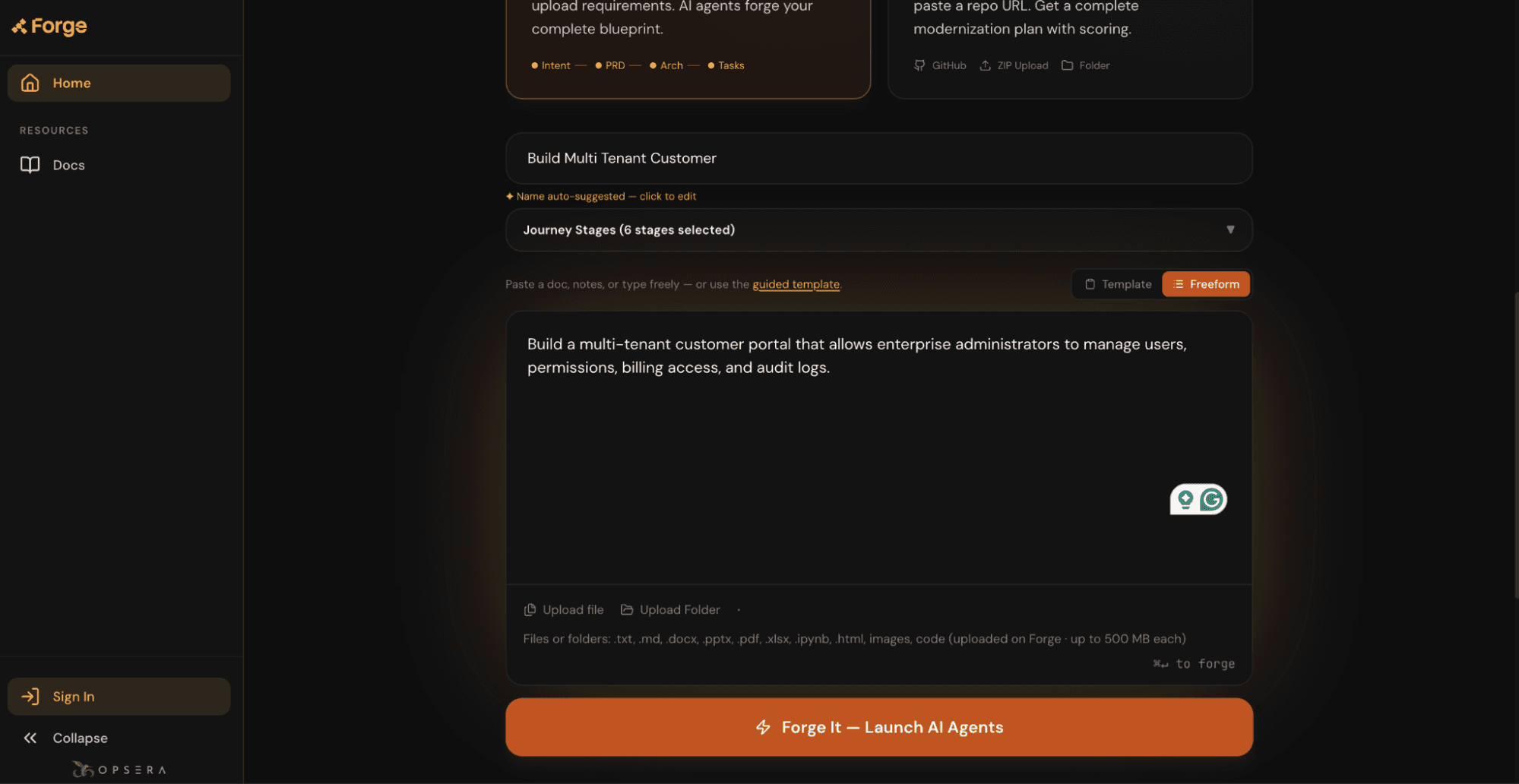
This screen shows the project initialization stage in SoftwareForge. Engineers provide a high-level description of the modernization objective, select the engineering journey, and launch the AI agents. Instead of immediately generating implementation code, the platform transforms this input into structured artifacts—including an Intent Profile, requirements, architecture, and governed work orders—creating a shared engineering foundation for the rest of the modernization lifecycle.
Recovering the System Before Rebuilding It
Converting COBOL into Java, C#, or another language is only one part of modernization. Before migration begins, teams must discover application boundaries, map dependencies across programs, databases, batch jobs, and external systems, and recover decades of embedded business rules. Based on those findings, they choose an appropriate strategy—such as API enablement, refactoring, rehosting, replatforming, or rebuilding—while using regression testing, security validation, and governance to ensure the modernized application preserves the original business behavior.
Why Enterprises Choose Modernization Over Replacement
Few organizations replace an entire COBOL estate simply because the language is old. The real drivers are decades of accumulated business logic, growing technical debt, rising maintenance costs, and a shrinking pool of engineers who understand these systems. Many applications also lack current documentation, making even routine changes difficult to assess and increasing the risk of unintended production impacts.
Modernization addresses these challenges by making legacy systems easier to understand, maintain, and extend while preserving the business behavior they have validated over years of production use. Rather than rebuilding proven applications from scratch, enterprises recover their architecture, dependencies, and business rules so they can evolve them with greater confidence and lower risk.
Most engineers know COBOL is old. Fewer appreciate how deeply it's threaded through the infrastructure that actually moves money, processes claims, and pays benefits. Before getting into strategy, it's worth establishing exactly what teams are up against, because the problem isn't the language itself: it's the decades of institutional knowledge embedded in the code, and the shrinking pool of engineers who can read it.
COBOL in Today's Enterprise Systems
The biggest challenge in COBOL modernization isn't the language itself—it's the decades of business logic embedded in large, interconnected systems. A single application may depend on hundreds of programs, shared COPYBOOKs, batch jobs, databases, and external interfaces, many of which have little or no documentation. Even a small change can have cascading effects that are difficult to predict.
This is why modernization begins with discovery rather than code conversion. Teams first recover dependencies, execution flows, and business rules before deciding whether to rehost, refactor, replatform, or rebuild an application. Without that understanding, migration risks increase significantly regardless of the target technology.
Discovering the Existing System Before Modernization
Before any modernization work begins, teams need a complete understanding of the COBOL application they plan to migrate. This includes mapping program dependencies, business rules, execution flows, and external integrations so that architectural decisions are based on verified system behavior rather than assumptions.
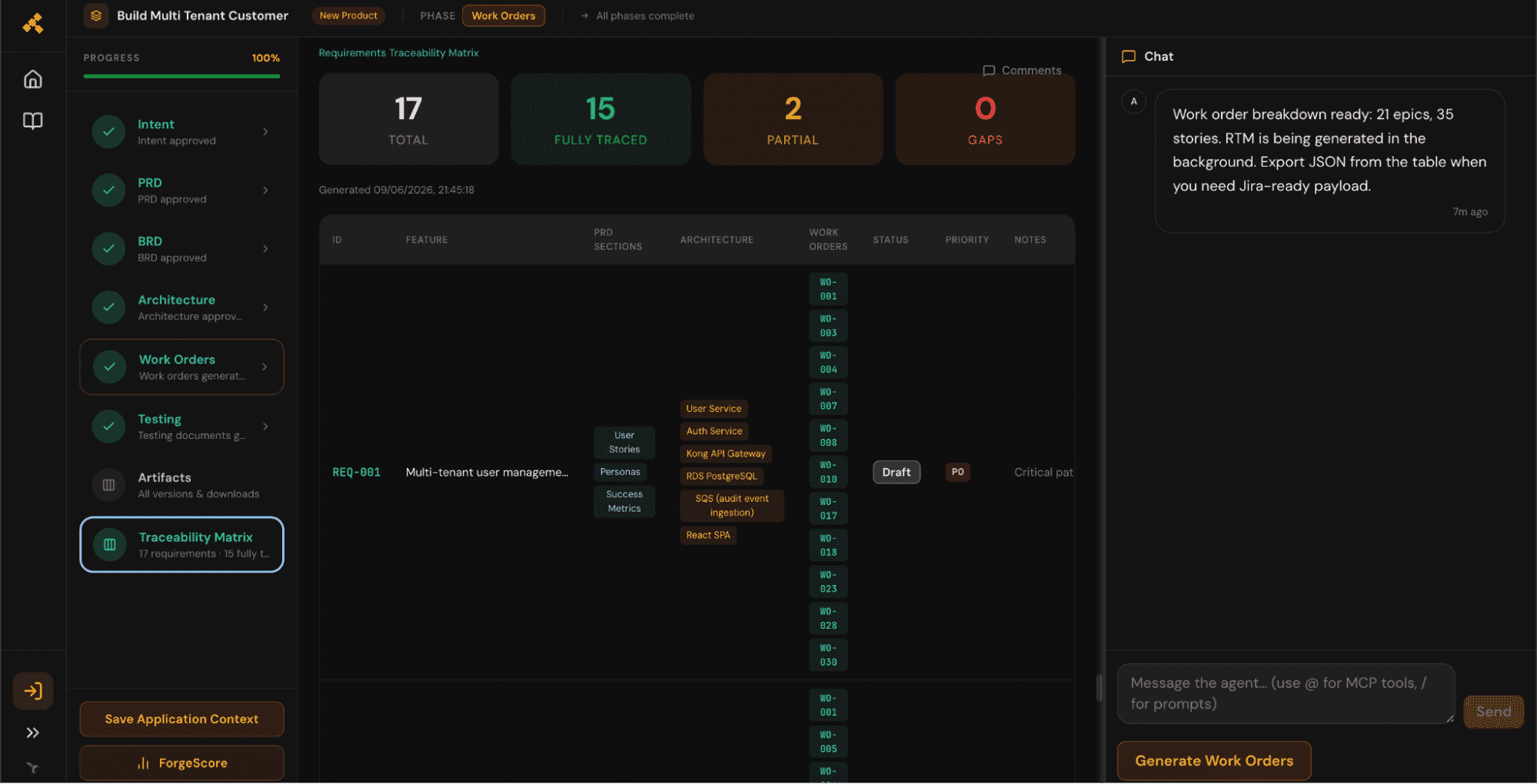
This screen illustrates SoftwareForge's Traceability Matrix, where approved requirements are linked to architecture decisions, work orders, and implementation artifacts. Instead of treating requirements as static documents, the platform maintains an auditable relationship between business intent and execution. Engineers can verify that every requirement is implemented, identify partially traced items, and generate governed work orders directly from approved specifications, improving visibility and reducing gaps throughout the modernization process.
Discovering Hidden Dependencies Across Programs, Databases, And Batch Jobs
A mature COBOL application isn't a single codebase. It's an ecosystem of interdependent components: COBOL programs, COPYBOOK data definitions, JCL job streams, CICS transaction maps, VSAM and DB2 data stores, MQ message queues, batch schedulers like CA-7 or TWS, and external interfaces to upstream and downstream systems. Missing any of these in the dependency map means the migration plan is incomplete before it starts.
Modernization teams rarely struggle because of COBOL syntax. Hidden dependencies between programs, batch jobs, shared data structures, and external systems create far more migration risk. Visualizing those relationships explains why application discovery always comes before migration planning.
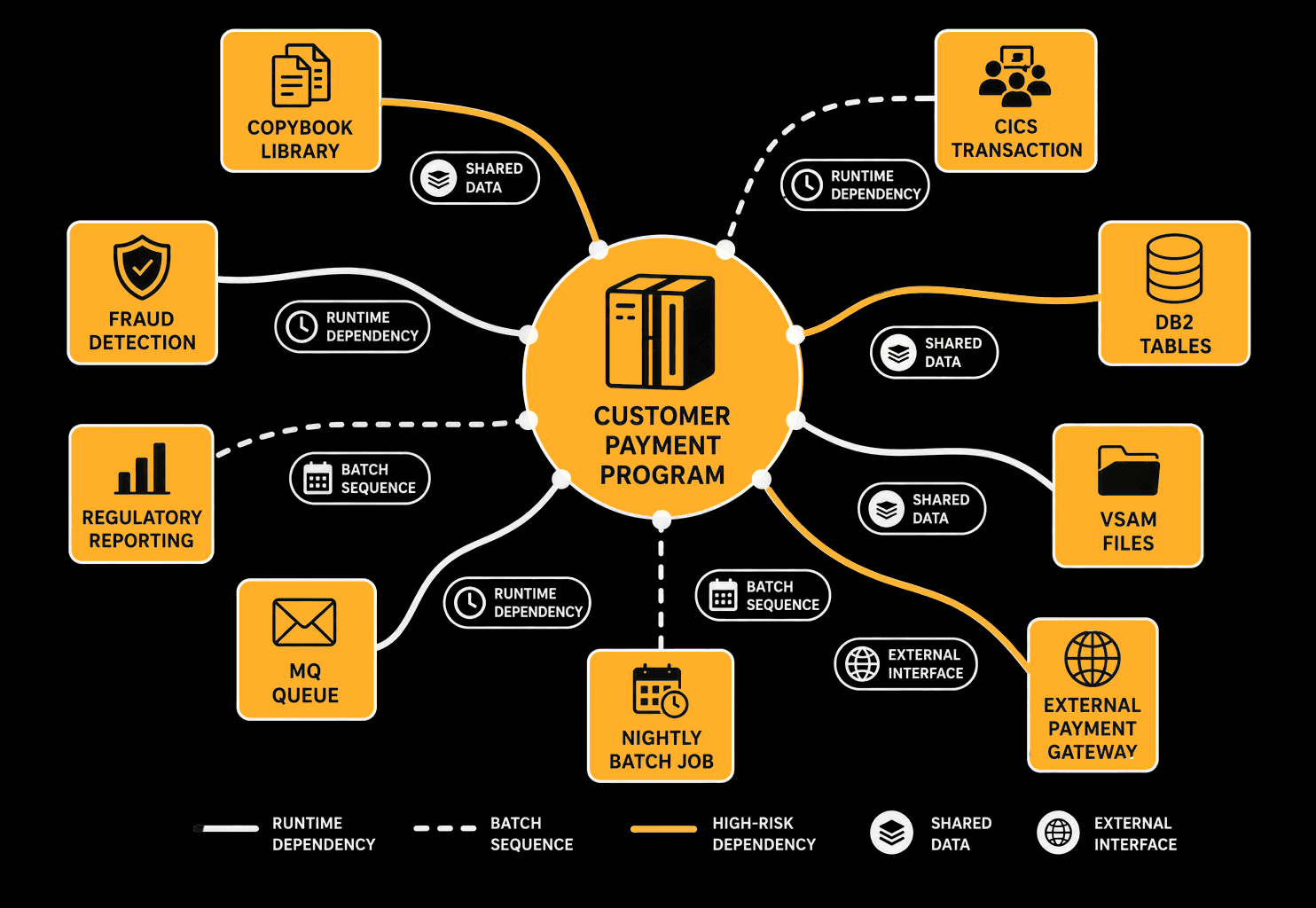
A dependency graph exposes coupling that isn't visible from source code alone. Engineers use these relationships to define migration boundaries, estimate effort, and avoid production failures caused by overlooked integrations.
AI-assisted analysis goes further by tracing execution paths through called subroutines, mapping data flows between modules, and documenting dependencies that span hundreds of files. The output is a dependency graph that teams can query: which programs would break if we modify this COPYBOOK? Which batch jobs share this VSAM file? What's the execution order constraint between these three programs?
Separating Business Rules From Infrastructure Dependencies
Once the dependency map exists, the next step is separating what the system does from how it does it on the current platform. A COBOL program running under CICS mixes business logic, screen handling, transaction management, and DB2 access in ways that are deeply coupled to the platform. Extracting the business logic requires understanding which parts of the code encode domain behavior versus which parts exist because of CICS conventions.
Common patterns in enterprise COBOL assessment:
Business rule density: Programs with high concentrations of PERFORM calls to named calculation routines contain extractable business logic.
Infrastructure markers: EXEC CICS, EXEC SQL, EXEC DLI blocks are platform-specific and don't carry business semantics.
COPYBOOK abuse: Shared COPYBOOK structures sometimes encode business domain concepts and sometimes encode database row layouts. Distinguishing them matters for deciding what becomes a domain object versus a DTO.
Conditional complexity: Programs with deep nested IF/EVALUATE trees often encode regulatory decision logic that must be preserved verbatim.
Building A Modernization Inventory That Teams Can Trust
Once application discovery is complete, teams need an inventory of everything that will be modernized. This includes applications, their dependencies, business criticality, ownership, and estimated migration effort. A complete inventory helps prioritize modernization work, identify high-risk systems, and track progress throughout the program. Without it, teams risk overlooking dependencies, misjudging effort, and planning migrations based on incomplete information.
Once the inventory is complete, teams can use it to prioritize modernization efforts. Applications are evaluated based on factors such as business criticality, dependency complexity, test coverage, compliance requirements, and estimated migration effort. This helps organizations identify low-risk applications for early migrations while reserving complex, business-critical systems for later phases, reducing overall delivery risk.
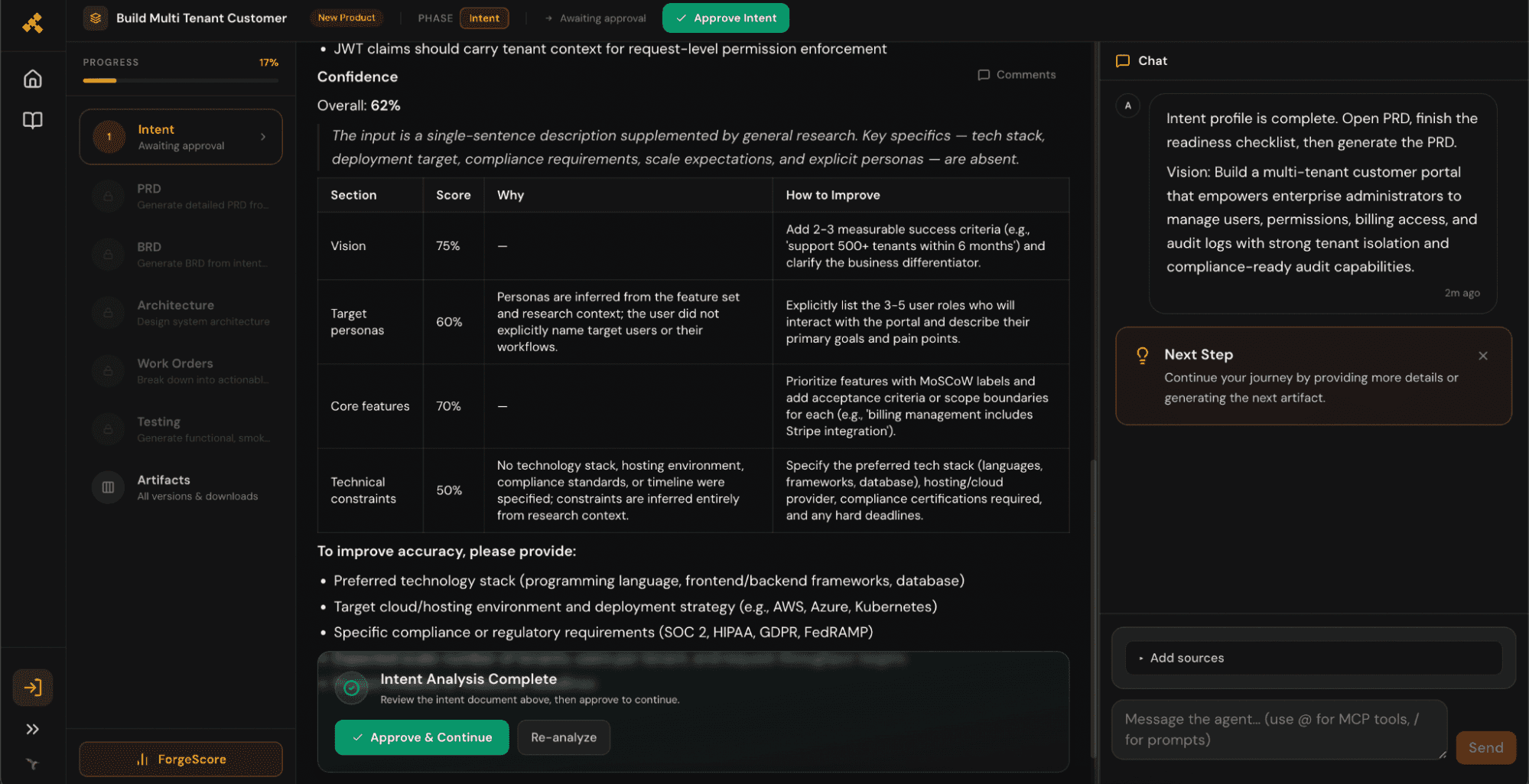
This screen shows the Intent Approval stage in SoftwareForge. Instead of immediately generating specifications from a short prompt, the platform evaluates whether the submitted intent contains sufficient business and technical detail. It scores key areas such as project vision, target users, core capabilities, and technical constraints, while highlighting missing information for the engineer to review. Only after the intent is approved does the workflow proceed to generate PRDs, architecture, and governed work orders, ensuring downstream artifacts are based on a well-defined engineering objective.
SoftwareForge's ForgeScore provides an eight-dimensional engineering assessment of legacy applications in minutes. It evaluates factors such as security exposure, architecture health, code quality, modernization readiness, dependency complexity, technical debt, compliance readiness, and AI readiness to help engineering teams understand the current state of an application before modernization begins. Rather than relying on manual discovery alone, teams receive a structured view of modernization risks and priorities that can be used to plan migration work with greater confidence.
ForgeScore Assessment - COBOL Payments Processing Module |
Choosing The Right COBOL Modernization Strategy For Different Applications
No single approach works across an entire COBOL estate. The right strategy for a batch payroll calculation engine differs from that for a CICS online transaction program handling 50,000 requests per hour. Choosing the wrong pattern for an application costs months of rework.
Rehosting, Refactoring, Replatforming, And Rebuilding Compared
The four major modernization approaches represent a spectrum from minimal change to complete replacement, with corresponding trade-offs in timeline, cost, risk, and long-term maintainability.
Rehosting moves workloads from the mainframe to a compatible runtime on commodity hardware or cloud infrastructure without changing the source code. Tools like Micro Focus Enterprise Server or AWS Mainframe Modernization's managed runtime execute COBOL natively outside z/OS. The advantage is speed: rehosting can move an application in weeks rather than years. The limitation is that you've moved the problem rather than solved it. The COBOL is still there, the same team needs to maintain it, and it still can't expose REST APIs without additional wrapping.
Refactoring restructures the source code while preserving functional behavior. Programs get decomposed into smaller units, shared mutable state gets eliminated, and CICS transaction logic gets separated from business rules. The code stays COBOL but becomes more modular and testable. Refactoring is appropriate for applications that need to remain on COBOL but need better maintainability and DevOps integration.
Replatforming translates the application to a new language while preserving the existing architecture and business logic. COBOL-to-Java is the most common path, with COBOL-to-Python and COBOL-to-Go gaining adoption where batch workloads are moving to cloud-native environments. AI-driven code refactoring has reached 70–85% automated conversion reliability for COBOL-to-Java in 2025, up from roughly 40% in 2020, though functional verification of the translated output remains essential.
Rebuilding discards the source code and reimplements the business requirements in a modern stack. Reserve rebuilding for applications where the source code has diverged so far from documented requirements that translation is impossible to verify, or where the domain model itself needs to change.
Matching Modernization Strategies To Application Risk And Business Value
High-value, low-complexity applications are the best place to start. They validate the migration toolchain, build team confidence, and demonstrate early outcomes to stakeholders. Batch reporting modules, standalone calculation engines, and peripheral integration services typically fit here.
High-value, high-complexity applications are the core of the program. These applications usually warrant the Strangler Fig approach with phased service extraction. Committing to a full replatform of a 2-million-line COBOL system with 400 inter-program dependencies and zero regression test coverage is an expensive way to find out the migration didn't work.
Not every COBOL application should follow the same modernization path. Migration strategy depends on operational risk, business importance, and dependency complexity rather than application size.
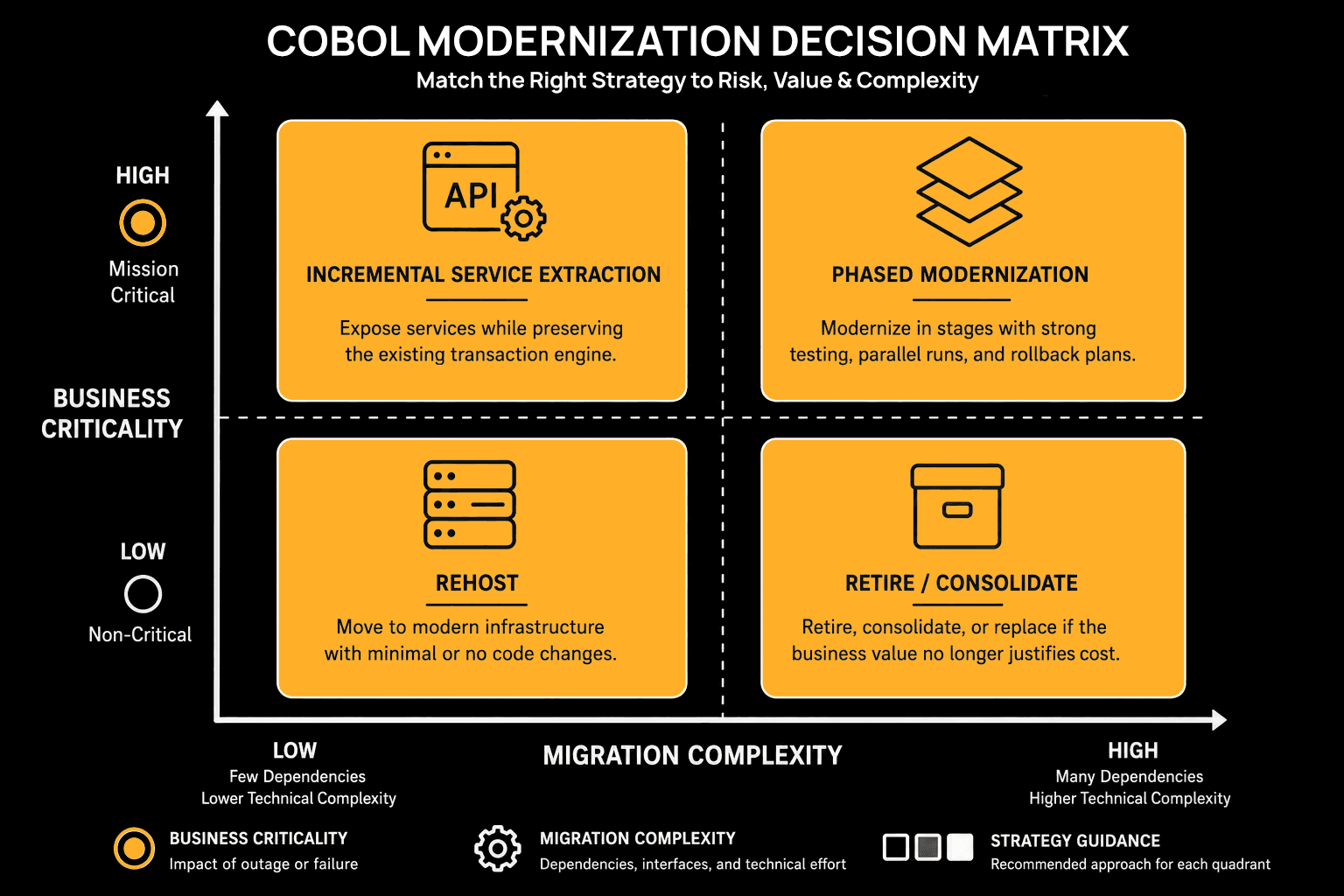
Migration planning becomes easier when applications are grouped by operational characteristics rather than by technology alone. Many enterprise portfolios end up using multiple modernization approaches simultaneously.
Low-value applications need honest evaluation. Some can be decommissioned rather than modernized. Others can be rehosted cheaply to extend their operational life while the high-value migration work proceeds. Treating every application as a modernization candidate spreads effort thin and delays delivery of the applications that actually matter.
Compliance requirements add constraints that override the value/complexity matrix. Applications touching payment card data, personal health information, or regulated financial calculations must meet compliance requirements in their target architecture before cutover, regardless of their position in the priority sequence.
Where AI Changes The COBOL Modernization Workflow
AI doesn't replace engineering judgment in COBOL modernization. It handles the parts of the workflow that don't require judgment: code reading, dependency tracing, documentation generation, and initial translation drafts. What took teams of consultants months of manual analysis can now be produced in hours, leaving engineers to spend their time on decisions that actually require domain expertise.
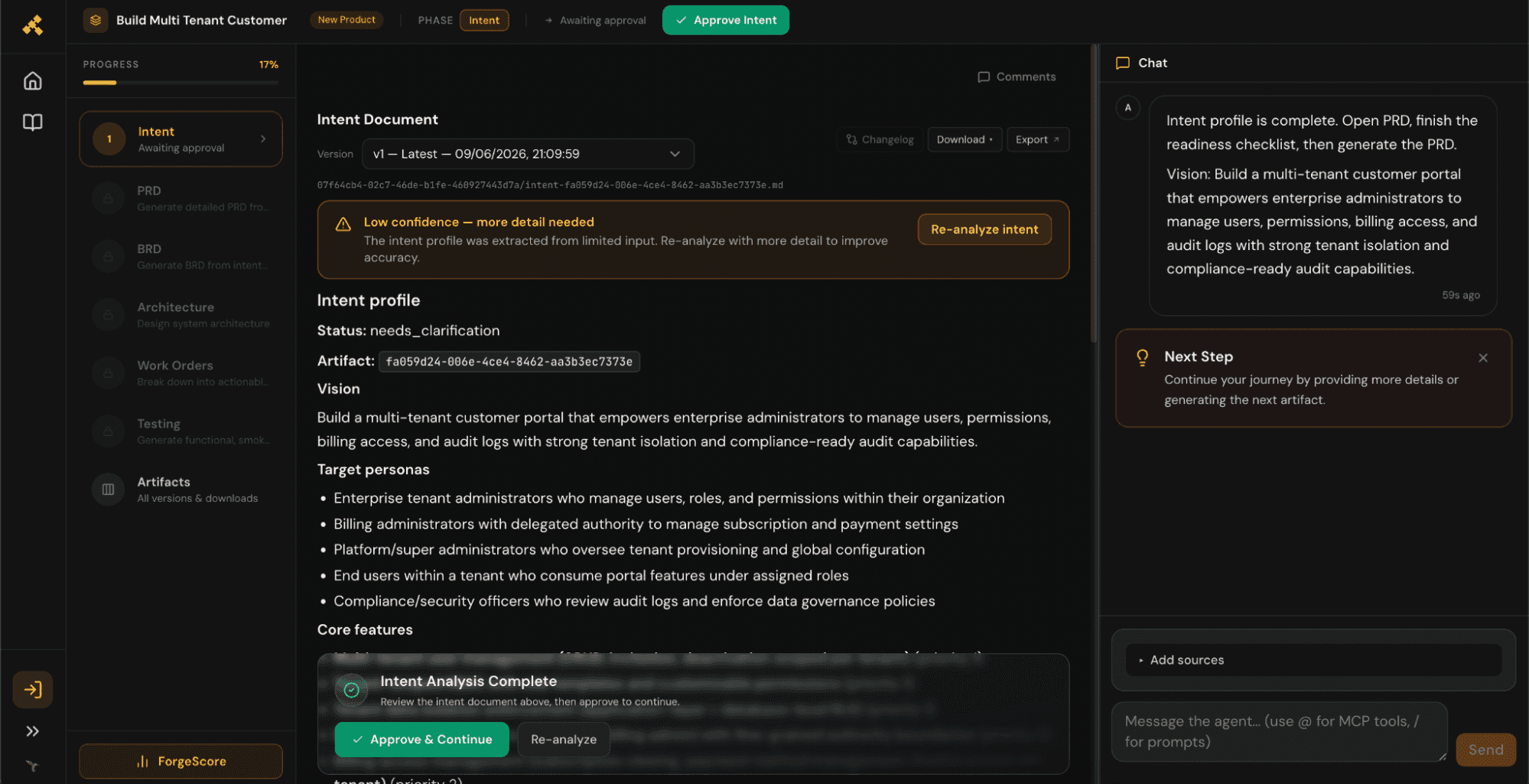
This screen shows the Intent Review stage, where SoftwareForge converts an initial modernization request into a structured engineering document. The platform identifies missing or low-confidence information, allowing engineers to refine the project intent before generating PRDs, architecture, and work orders. By validating requirements at the beginning of the workflow, teams establish a reliable foundation for every subsequent modernization activity.
Using AI To Understand Legacy Code Before Migration Begins
The first AI-assisted phase is understanding: what does the code do, what does it depend on, and what business rules does it encode? AI identifies program entry points, traces execution paths through called subroutines, maps data flows between modules, and documents dependencies spanning hundreds of files. Shared data structures, file operations that create coupling between modules, and initialization sequences that affect runtime behavior don't show up in static analysis alone; AI-assisted analysis catches these implicit dependencies by observing data flow patterns rather than just syntax.
An 18,835-line COBOL program takes human analysts days to document manually. AI produces an initial structural analysis in minutes, covering program structure, data flows, and dependency lists. Human engineers then review the output for accuracy, add context from operational knowledge, and fill in gaps where the AI flagged ambiguity. The combination is faster than either approach alone, and the AI-generated documentation creates a reviewable artifact that didn't exist before.
AI-Assisted Translation, Validation, And Test Generation
After the analysis phase, AI assists with three translation tasks: translating code into the target language, generating regression tests, and performing semantic validation.
For code translation, the Microsoft Azure approach uses a JavaConverterAgent that receives structured analysis as input and produces Java (Quarkus) output. The key insight from their implementation is that translation accuracy drops when context is too large. When analysis output was passed wholesale to the conversion agent, the model lost coherence on complex call chains. Breaking translation into program-sized chunks with explicit context about the calling environment produced better output.
AI-generated code needs validation before deployment. Architecture review, regression testing against the golden dataset, security scanning, and compliance verification are all required steps. AI output that passes regression testing against production data is significantly more trustworthy than AI output reviewed only by reading the code, but it still needs human sign-off before going anywhere near production.
Why Governance Matters More Than Faster Code Conversion
Speed of code generation isn't the bottleneck in enterprise COBOL modernization. Getting generated artifacts through review, approval, security scanning, and compliance validation is the bottleneck, and teams that don't build governed workflows around AI-generated output end up with a pile of translated code they can't safely deploy.
AI shortens analysis and translation work, but enterprise modernization still depends on engineering review. Every generated artifact moves through validation before reaching production.
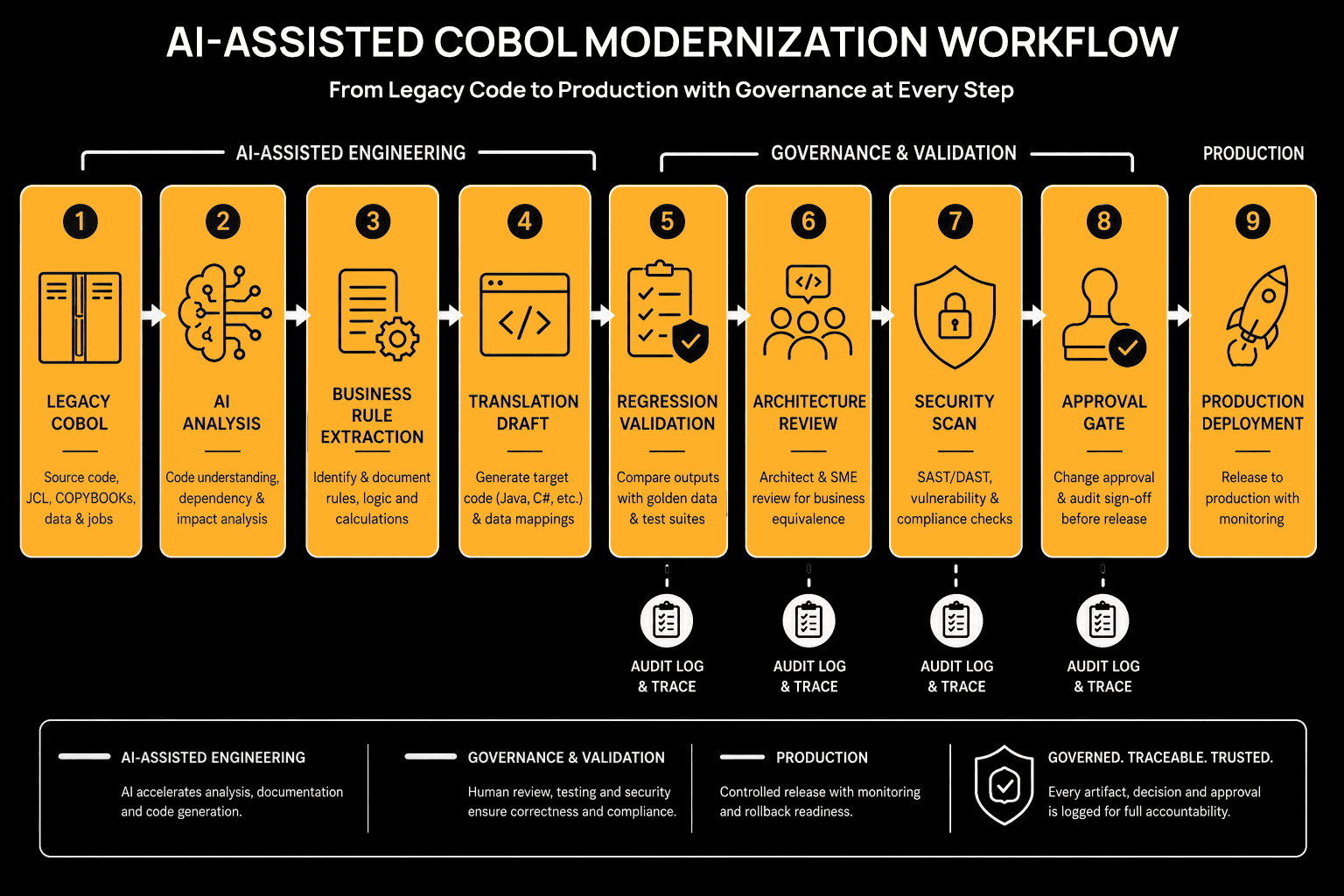
The value of AI comes from reducing manual analysis, not bypassing engineering controls. Review stages preserve business behavior, compliance requirements, and production stability throughout the modernization process.
Governed modernization workflows solve this by making review and validation part of the pipeline rather than a post-generation step. Every AI-generated artifact goes through a defined sequence: an automated security scan, an architecture review gate, a compliance check against policy definitions, human approval by a named owner, and an audit trail entry. Work Orders in SoftwareForge encode this sequence explicitly: no artifact progresses until all gates are cleared, and every gate produces a log entry.
The PRD for a COBOL modernization engagement in SoftwareForge captures this structure:
# Forge Modernization Work Order: LNPYMTCALC → Java |
The audit trail produced by this workflow meets the needs of regulated industries. Every decision has a timestamp, an owner, and a reason. Regulators asking about change management controls get a complete, queryable record rather than a Git commit history and a shrug.
Modernizing COBOL Without Breaking Production Systems
The moment AI-generated code meets production traffic is when theoretical confidence becomes operational reality. Teams that plan this phase carefully avoid the most expensive category of modernization failure: deploying a system that passes testing but fails in production because the test environment didn't accurately reflect production conditions.
Building Regression Tests Around Business Behavior Instead Of Source Code
Code structure changes during modernization. Business behavior must not. A regression test suite that validates code structure (checking that specific methods exist, that classes implement specific interfaces) will pass for the wrong implementation and fail for the right one if the structure changes. Tests that validate business behavior, given these inputs, the system produces these outputs, remain valid across any implementation language and architecture.
Building a behavioral regression suite for COBOL starts with transaction capture. Production COBOL systems log input/output pairs at the transaction level, or they can be instrumented to do so. Capturing six months of production transactions produces a dataset that covers edge cases, regulatory scenarios, and seasonal processing patterns that a manually constructed test suite would miss. Converting captured transactions into test cases follows a straightforward pattern: serialize inputs and expected outputs, replay them through the new implementation, and assert an exact match.
Reconciliation testing adds a second validation layer. Run the COBOL system and the modern implementation in parallel against the same input stream. Compare outputs record by record. Any divergence, down to rounding differences in cent calculations, gets flagged for investigation before it becomes a production defect. The mathematical precision that COBOL's PIC 9(10)V99 decimal arithmetic provides isn't automatically reproduced by Java's double type; it requires explicit use of BigDecimal with matching precision and rounding modes.
Measuring Modernization Progress Beyond Lines Of Converted Code
Lines of converted code are a meaningless metric for modernization progress. A program can be translated with 98% syntactic accuracy and 60% semantic accuracy. The 40% that's semantically wrong is what causes production incidents, not the 2% that didn't translate.
Metrics that actually reflect modernization quality:
Regression coverage percentage: what fraction of known production transaction patterns are covered by the behavioral test suite? Coverage below 80% means the testing regime has gaps large enough to hide meaningful defects.
Parallel execution divergence rate: during shadow deployment, how often does the modern system's output differ from the COBOL system? A divergence rate above zero on calculation outputs needs investigation before promotion.
Defect escape rate: how many defects reached the shadow environment that weren't caught by automated testing? Escaped defects indicate testing gaps that should be closed before broader promotion.
Deployment frequency: teams that can deploy modernized services on a regular cadence have eliminated the batch-release risk that kills big-bang migrations. Deployment frequency measures whether the modernization workflow is actually producing deployable artifacts.
Time to rollback: if parallel production diverges, how long does it take to restore the COBOL system as authoritative? Rollback time measures operational resilience, not modernization progress, but it's a risk indicator that executive teams should track.
SoftwareForge's Modernization Blueprint tracks 4,168 hours of technical debt cleared and projects monthly savings based on reduced maintenance load, avoided compliance remediation, and operational cost reduction. These are the metrics that justify the program budget to boards and CFOs, not line counts.
Two Common Failure Modes In COBOL Modernization Projects
Understanding why modernization programs fail is as useful as understanding what makes them succeed. The three patterns below account for the majority of costly failures in enterprise COBOL migration.
Treating COBOL As A Translation Problem Instead Of A Business Logic Problem
Many modernization projects begin by translating COBOL into Java or another language without first understanding the business rules embedded in the application. While the converted code may compile and pass basic functional tests, production issues often appear when rarely used business scenarios, regulatory calculations, or batch processing logic behave differently from the original system.
A common example is a financial calculation module where decades of regulatory updates exist only as conditional branches in the COBOL code. If those rules are translated without understanding their business purpose, the new application may produce incorrect results for edge cases that occur only during audits, month-end processing, or specific customer scenarios. Fixing these defects after deployment is far more expensive than identifying the business logic during the discovery phase.
Successful modernization therefore starts with recovering business rules, validating application behavior, and documenting requirements before translation begins. Code conversion becomes one step in the process rather than the modernization effort itself.
Even when teams understand the business logic correctly, another common failure appears during implementation. As AI-assisted translation becomes part of modernization workflows, the challenge shifts from generating code to verifying that the generated artifacts preserve the original system's behavior and comply with engineering standards.
Trusting AI Output Without Verification Pipelines
AI-generated code is a draft, not a deliverable. Developer trust in AI output accuracy has dropped to 29%, down from 43% the prior year, even as AI code generation continues to increase. The drop reflects experience: teams that deployed AI-generated code without adequate verification encountered defects that adequate verification would have caught.
Specifically for COBOL modernization, the verification requirements are stricter than for greenfield development. The system being replaced is authoritative. Any divergence between the COBOL output and the modern system's output on the same input is a defect, not a difference of opinion about implementation style. The behavioral regression suite exists specifically to catch these divergences systematically. No AI-generated artifact should reach the parallel execution environment without passing the full regression suite against production-captured transactions.
Architecture review catches a different category of problem: the translation is functionally correct but introduces architectural characteristics (synchronous blocking, where the COBOL used async batch processing, and unbounded result sets, where the COBOL paged through VSAM in fixed chunks) that will cause production issues under load. Human engineers with domain knowledge catch these; automated regression testing doesn't.
Verification pipelines don't slow modernization down. They prevent the kind of production failure that sets modernization programs back by six months and erodes the organizational confidence needed to continue.
How Software Factories Bring Structure to Enterprise Modernization
Enterprise modernization is not a series of isolated AI interactions. Large organizations often manage millions of lines of legacy code spread across hundreds of applications, making modernization a coordinated engineering effort rather than a coding exercise. Software factories introduce structure by connecting requirements, architecture, governance, and implementation through standardized workflows. Instead of relying on individual prompts or disconnected automation, they provide repeatable processes, traceability, and controlled execution that allow modernization efforts to scale while maintaining architectural consistency and compliance.
Moving From AI Prompts To Governed Modernization Workflows
AI-generated code alone isn't enough for enterprise modernization. Individual prompts produce artifacts that lack traceability, review history, and a clear connection to business requirements, making them difficult to validate or audit across large engineering teams.
Governed workflows solve this by introducing repeatable stages for AI analysis, security scanning, regression testing, architecture review, and approvals. Every artifact follows the same process, making modernization more consistent and easier to verify.
Every modernization project starts by onboarding the existing application into the software factory. Rather than immediately generating code, SoftwareForge first ingests the legacy codebase and supporting artifacts, establishing the foundation for dependency analysis, specification generation, and migration planning.

SoftwareForge supports this approach through Living Specifications, which capture business intent, compliance requirements, and project scope before implementation begins. Combined with governed Work Orders, engineering teams can validate every generated artifact against a documented specification instead of relying on individual knowledge or manual reviews.
Where SoftwareForge Fits Into Enterprise Modernization Programs
Consider a bank modernizing a COBOL-based loan processing system. Before any code is translated, SoftwareForge analyzes the application, captures business intent, generates Living Specifications, and identifies dependencies across programs, databases, and external interfaces. These artifacts become governed Work Orders that guide AI-assisted analysis, code generation, testing, and approvals. Throughout the process, every change is validated against architecture, security, and compliance requirements, creating an auditable trail from the original modernization request to the final deployment.
Pointing SoftwareForge at a legacy COBOL repository triggers the ForgeScore assessment, which produces an 8-dimensional readiness score in minutes along with a recommended modernization strategy and effort estimate. Teams use this output for portfolio prioritization rather than manual assessment, compressing weeks of consultant-driven discovery into a same-day deliverable.
SoftwareForge supports COBOL modernization by reducing the manual effort involved in application discovery, documentation, and migration planning. It generates Living Specifications from legacy applications, maps dependencies across programs and shared data structures, and creates governed Work Orders that guide AI-assisted translation, testing, and approvals. This gives engineering teams a consistent way to modernize large application portfolios while preserving business logic, maintaining traceability, and enforcing architecture and compliance requirements throughout the migration lifecycle.
Engineering COBOL Modernization For Long-Term Success
COBOL modernization is successful when it treats legacy systems as repositories of business knowledge rather than code that simply needs to be translated. Throughout this article, we've seen that application discovery, dependency mapping, business rule recovery, migration planning, regression testing, and governance are all prerequisites for safe modernization. AI accelerates many of these activities, but it does not replace engineering judgment or verification.
The key lesson is that successful modernization is driven by understanding before implementation. Teams that recover application context, choose the right migration strategy, validate business behavior, and execute changes through governed workflows reduce migration risk while preserving decades of proven business logic. The goal is not just to move COBOL to a modern platform, but to build a system that remains maintainable, extensible, and trustworthy for the next generation of enterprise applications.
SoftwareForge applies these engineering principles by providing a governed modernization workflow rather than another AI code generation tool. Living Specifications, ForgeScore assessments, and governed Work Orders help teams recover application context, prioritize migration efforts, and execute modernization with traceability from discovery through deployment. For large COBOL modernization programs, this provides the structure needed to preserve business logic, reduce migration risk, and maintain governance as applications evolve.
FAQs
What Is The Safest Approach To COBOL Modernization For Critical Banking Systems?
Incremental modernization is generally the preferred approach for banking workloads. Parallel execution, comprehensive regression testing, and phased service extraction reduce operational risk while preserving business continuity.
Can AI Translate COBOL Applications Without Manual Review?
No. AI can support code analysis, documentation, translation, and test generation, but engineering teams must validate business behavior, architecture, security, and production readiness before deployment.
How Long Does A Typical COBOL Modernization Project Take?
Project duration depends on application complexity, dependency depth, testing maturity, regulatory requirements, and migration strategy. Large enterprise portfolios are commonly modernized over multiple phases rather than a single release.
Should Enterprises Rewrite COBOL Applications Or Modernize Them Incrementally?
Most organizations choose incremental modernization because it reduces deployment risk and preserves business continuity. Complete rewrites are generally reserved for applications whose architecture or business requirements have fundamentally changed.


