Blog / AI-SDLC
Software Factory: Intent-Driven Development At AI Speed


Nasssir Khan
Head of Product Marketing & GTM
TL;DR
Standard AI assistants lack systemic memory, accelerating syntax generation while inducing severe context rot and architectural drift. By operating in silos, they compress typing time but expand technical debt and change-failure rates across enterprise repositories.
SoftwareForge shifts execution from raw prompts to Work Orders, the machine-readable primitives with strict constraints and human sign-offs. Because agents cannot commit code without an approved cryptographic reference, unapproved or non-compliant alterations are blocked upstream.
Instead of treating constraints as volatile prompt inputs, modern software factories deploy a persistent, version-controlled context layer. This architecture feeds live security policies, interface contracts, and design mandates directly into agent workflows.
Modern software factories use semantic code analysis and dependency mapping to reverse-engineer undocumented legacy monoliths and mainframes. This automated discovery extracts forgotten business rules and regenerates living specifications, clearing a risk-managed path for modernization.
The primary financial return of an AI-SDLC comes from addressing coordination overhead and upstream misalignment. By instantiating an unbroken chain from intent to deployment, it compresses 12- to 16-week feature cycles into mere hours.
What Is A Software Factory, And Why Are Enterprises Moving Beyond AI Code Assistants?
AI code assistants can generate code quickly, but they don't retain the engineering context behind it. They don't know why an architectural decision was made, which internal API is deprecated, or which security constraint exists only in design reviews. The generated code may compile and pass tests, yet still violate decisions that were never captured in code or documentation.
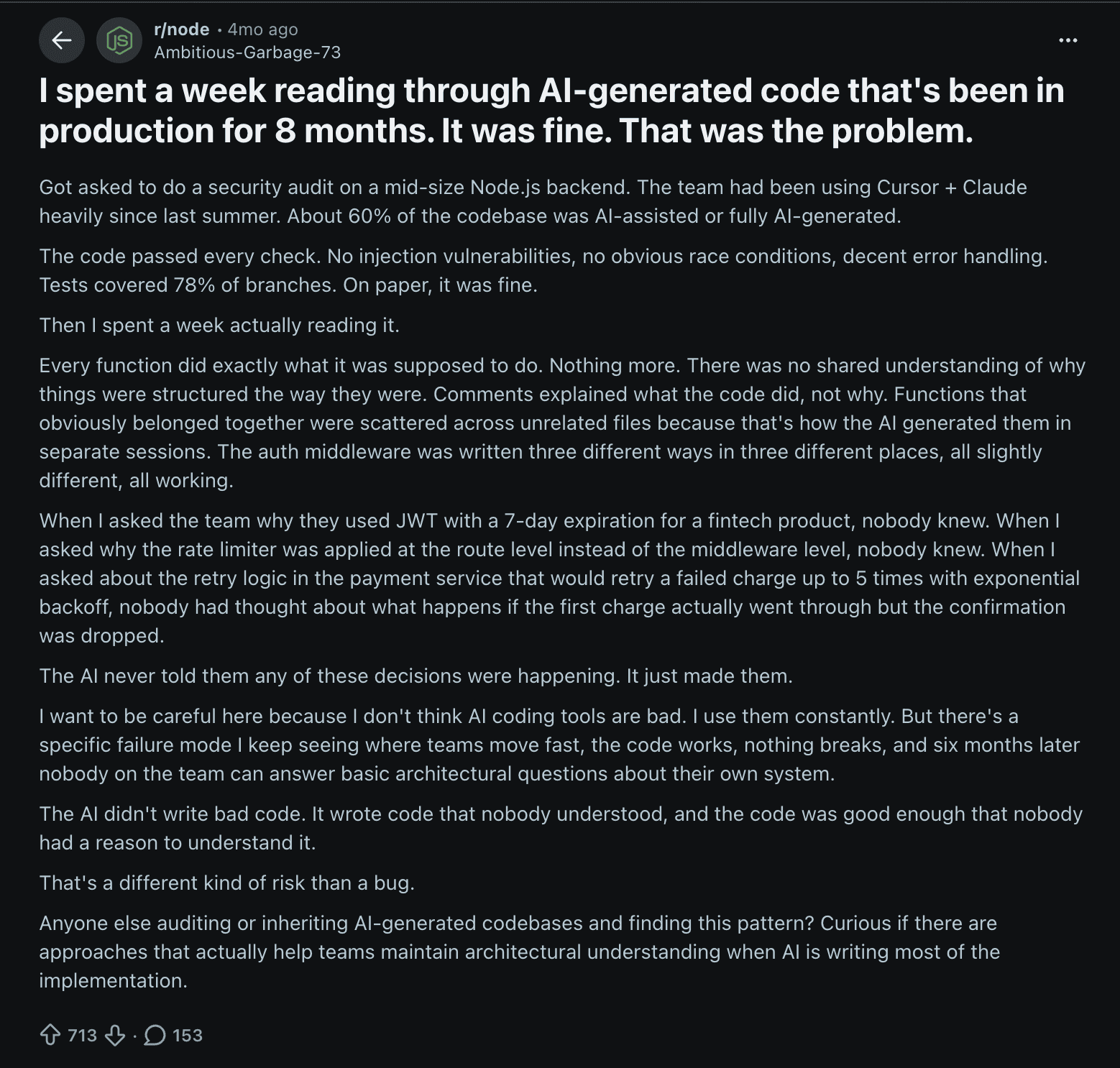
That limitation matters because AI-assisted development is becoming the norm. Gartner projects that 90% of enterprise software engineers will use AI code assistants by 2028, up from less than 14% in early 2024. In one widely discussed 2026 Reddit thread, engineers described inheriting AI-assisted codebases that passed tests yet lacked any shared rationale for architectural decisions, resulting in duplicated patterns, inconsistent implementations, and code that was difficult to evolve because the original engineering intent had effectively disappeared.
A software factory addresses a different part of the software lifecycle. Instead of beginning with code generation, it begins with intent engineering, converting business requirements into machine-readable specifications that guide implementation. Unlike AI code assistants, which primarily generate code within the current context, software factories maintain persistent context across the SDLC, preserving architecture, security policies, compliance requirements, and traceability from business intent to deployment.
SoftwareForge is one example of this approach. According to its official documentation, it converts business intent into machine-readable specifications, including PRDs, FRDs, architecture, and security requirements, before implementation starts. Every Work Order maintains traceability back to an approved business objective, reducing reliance on chat history or individual developer memory.
This article explains how a software factory differs from an AI code assistant, how intent-driven development works across the AI-SDLC, and why enterprises are moving beyond code generation toward governed software delivery.
AI assistants accelerated one part of the SDLC and created friction in several others. Understanding where the gap sits is the prerequisite for understanding what a software factory is actually solving.
The Problem With Stateless Code Generation
Today's AI agents function as stateless "speed developers." They lack architectural judgment, leading to drift, ambiguity, and hallucinations that proliferate faster than teams can review. A GitHub Copilot or Cursor session has no memory of the PRD your product manager wrote, the security review that flagged JWT token expiry requirements, or the architecture decision record that said this service must not call the payments API directly. Each session starts from whatever context fits in the current window.
The result is architectural drift: code that compiles, passes basic tests, and ships, but diverges from the system design incrementally until someone catches it in production or during a security audit. At scale, enterprises already spend 40 to 50 percent of their engineering budgets maintaining legacy code, applications whose original intent is blurred, context is gone, and a governance trail does not exist. Layering AI on top of that baseline without changing the workflow produces more code faster and more technical debt faster.
The 2025 DORA report confirms that AI adoption correlates positively with software delivery throughput. However, it also finds that AI adoption continues to correlate with greater instability, leading to more change failures, increased rework, and longer cycle times for resolving issues.
Why Teams Are Shifting To AI-SDLC Workflows
The shift from isolated AI coding tools to AI-SDLC systems is not about abandoning code assistants. It is about adding the governance layer that code assistants were never designed to provide. Teams make this move because the failures described above context loss, architectural drift, and compounding technical debt are not code-generation problems. They are lifecycle problems, and faster generation does not solve them. Addressing them requires moving compliance, security scanning, and architecture conformance upstream, into the specification layer, rather than chasing them through code review after generation is complete.
That distinction matters most for platform engineers and security leaders. When every AI-generated artifact is traceable to an approved specification, and every specification is traceable to a business requirement, the audit trail exists by construction rather than by convention.
A software factory is how teams put the AI-SDLC model into practice. It transforms raw intent into governed, spec-based development with guardrails, delivering enterprise-ready applications at scale, which is what the rest of this article examines.
What A Modern Software Factory Does
The core function of a software factory is to convert a business request into a set of machine-readable artifacts that govern what AI agents are permitted to build, and then execute those artifacts under human authorization. That flow has three stages: capturing intent, generating specifications, and controlling execution.
From Intent To Executable Work Orders
Consider a standard enterprise request: "We need a customer notification service that sends order updates via SMS and email, complies with GDPR opt-out requirements, and integrates with our existing messaging queue."
In a traditional AI-assisted workflow, a developer takes that request, writes some tickets, maybe sketches a design, then opens their code assistant and starts building. The GDPR constraint may or may not be implemented. The messaging queue integration style may or may not match what the platform team standardized six months ago. Nobody will find out until code review, and by then the cost of fixing it will be higher than if the constraint had been explicit from the start.
A software factory like SoftwareForge takes a different path: intent analysis, requirements generation covering PRD, BRD, and FRD documents, architecture design, security and compliance checks, and controlled execution through work orders, all before code generation begins. Specs are generated in approximately three minutes, and the workflow reduces concept-to-delivery from typical 12- to 16-week cycles to hours by eliminating upstream rework.
This screen shows the initial intake of raw business intent inside SoftwareForge. Instead of an autocomplete chat box, it gives the team a structured freeform canvas specifically tied to a multi-stage delivery pipeline.
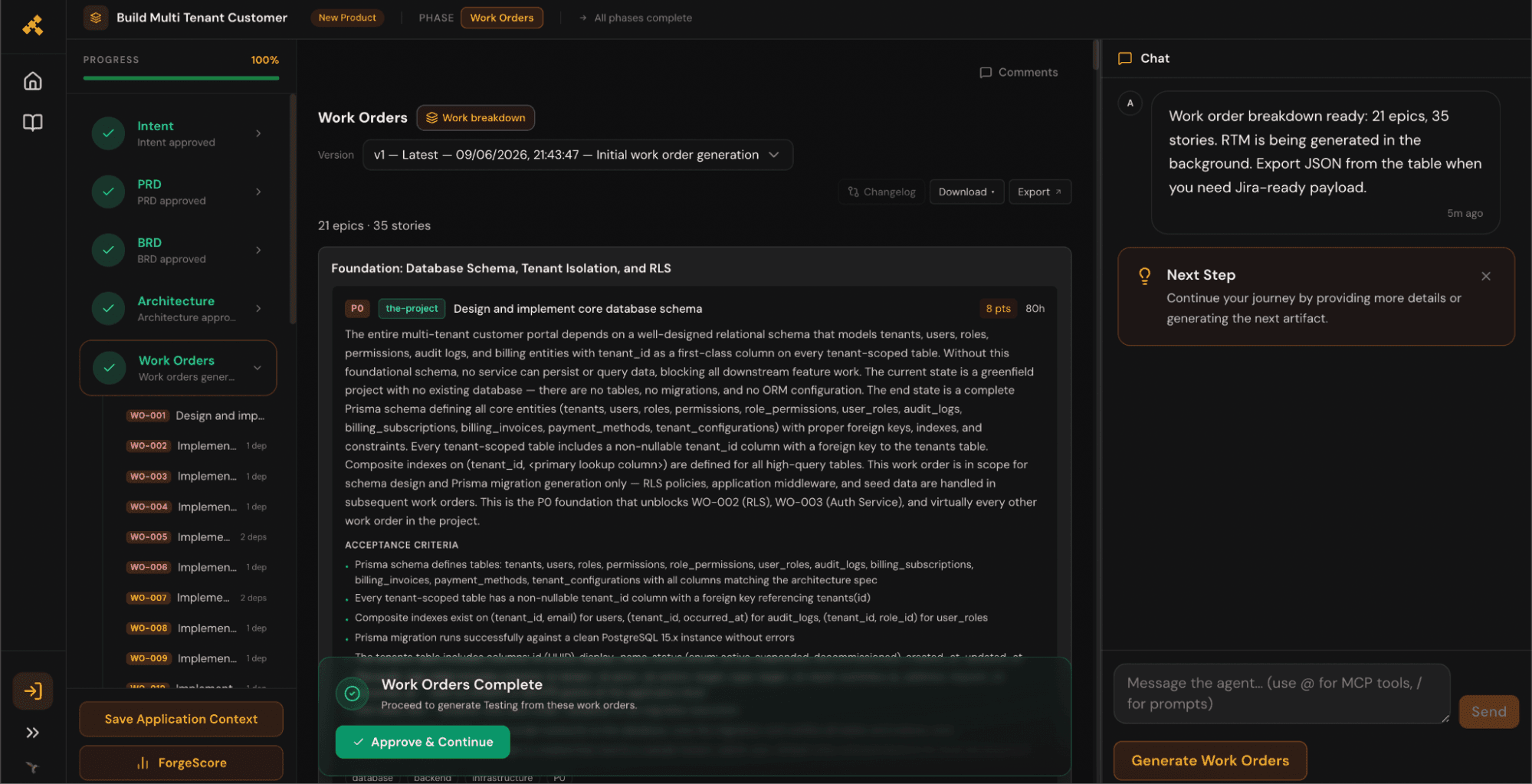
The work order is the key execution primitive. It specifies what an AI agent is authorized to do, against which component, under which constraints, and with which approval already on record. An agent cannot ship code without an approved work order, so unapproved changes cannot silently enter the codebase. Here is a representative structure for a work order artifact as it would appear in a governed AI-SDLC:
{ |
Every field in that structure is machine-readable by the executing agent and auditable by a compliance reviewer. The agent knows exactly what is allowed to build. The reviewer can trace every code change to the requirement, security review, and architecture decision that authorized it.
Why Context Preservation Matters More Than Code Generation
Generating code is the easy part. Keeping the business rules, compliance requirements, and architectural decisions attached to that code throughout its lifecycle is where most AI-assisted workflows fail.
The failure mode has a name: context rot. It happens when specifications live in one place, architecture decisions live in another, security requirements exist in a third tool, and none of them are linked to what the agent is currently generating. The agent fills the gaps with plausible-looking code that satisfies the immediate test but ignores the constraint documented on a Confluence page that nobody thought to include in the prompt.
While standard AI assistants accelerate individual code generation, they operate within isolated memory limits. This visual highlights why scaling AI without a foundational context results in catastrophic systemic drift.
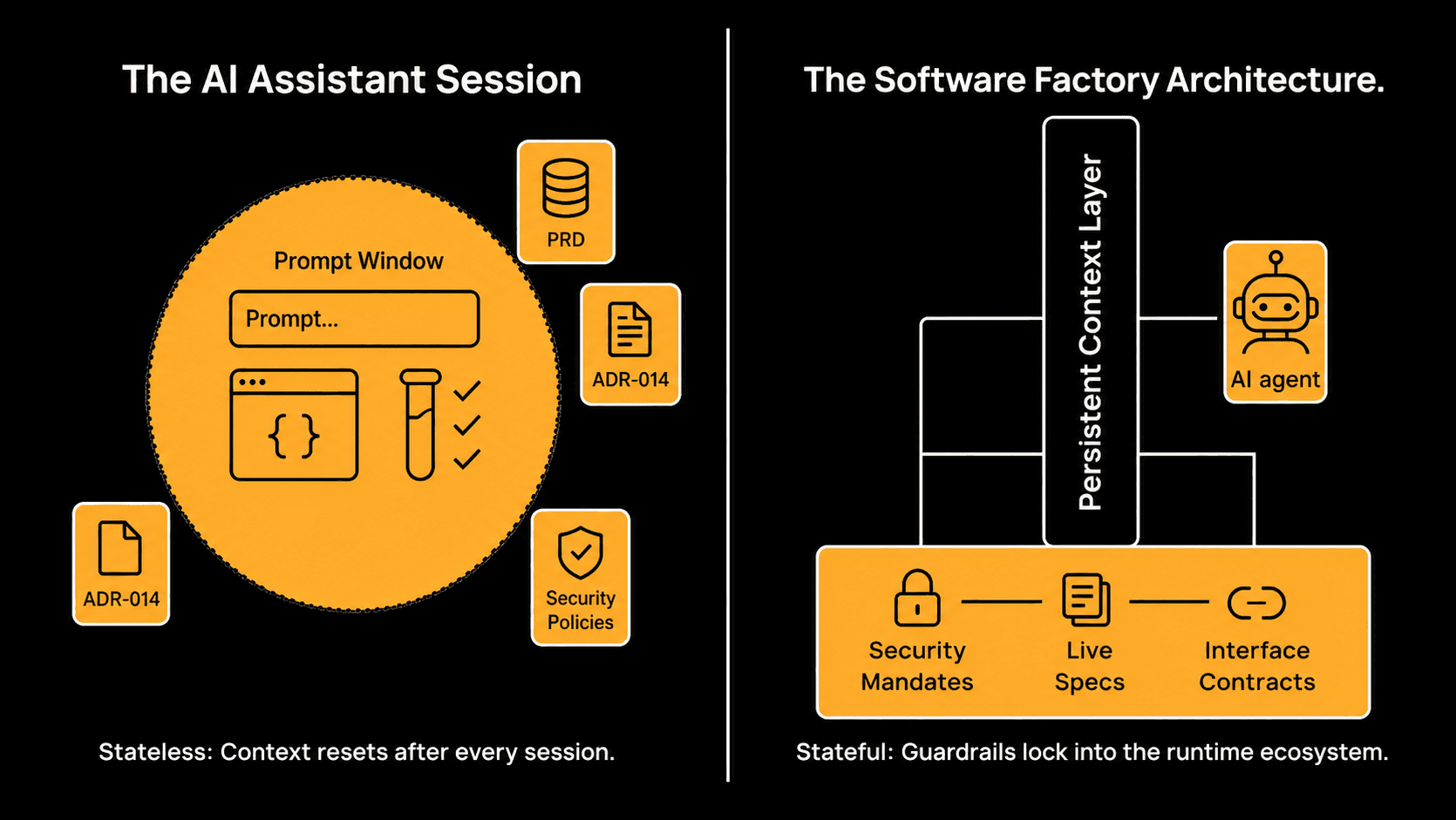
A software factory treats context as a persistent asset, not a one-time prompt input. It captures architectural standards, security policies, coding standards, and compliance mandates as part of a context layer that persists from day zero throughout the software's life, so agents do not hallucinate and deliver code that meets enterprise requirements.
How Software Factories Differ From Traditional Software Factories
The term "software factory" predates AI by several decades. Microsoft formalized the concept in 2004, focusing on domain-specific modeling languages, reusable asset libraries, and template-driven code generation. The initiative focused on developing model-driven engineering technologies that leveraged domain-specific knowledge to automate software modeling tasks, providing developers with frameworks for building development environments that transformed abstract models into implementations.
The comparison looks like this:
Dimension | Traditional Software Factory | AI Software Factory |
Starting point | Predefined domain model and templates | Raw business intent in natural language |
Specification source | Human-authored, stored separately | Machine-generated from intent, versioned with code |
Context persistence | None: templates are stateless | Persistent context layer across the full lifecycle |
Execution control | Template application, batch generation | Human-authorized work orders per change |
Legacy handling | Requires a clean domain fit | Reverse-engineers existing systems into living specs |
Compliance | Enforced via template constraints | Policy engine attached to every work order |
The Intent-Driven Development Workflow
Intent-driven development is the methodology that a software factory implements. The key idea is that business intent is a first-class engineering artifact that gets versioned, validated, and linked to every downstream artifact it produces.
Capturing Intent As A Versioned Artifact
A natural-language chat prompt is not intent in the software factory sense. "Add SMS notifications to the order flow" is a starting point, not a specification. A versioned intent artifact is structured, constrained, and queryable by machines.
SoftwareForge captures intent as a human and machine-readable, living artifact and carries it all the way to production. Intent is the business reason behind software. Today, intent gets lost the moment a product manager hands off a requirement to an engineering team.
A well-formed intent artifact includes the business objective, measurable acceptance criteria, explicit constraints (regulatory, technical, operational), security requirements, integration boundaries, and non-negotiable architectural decisions.

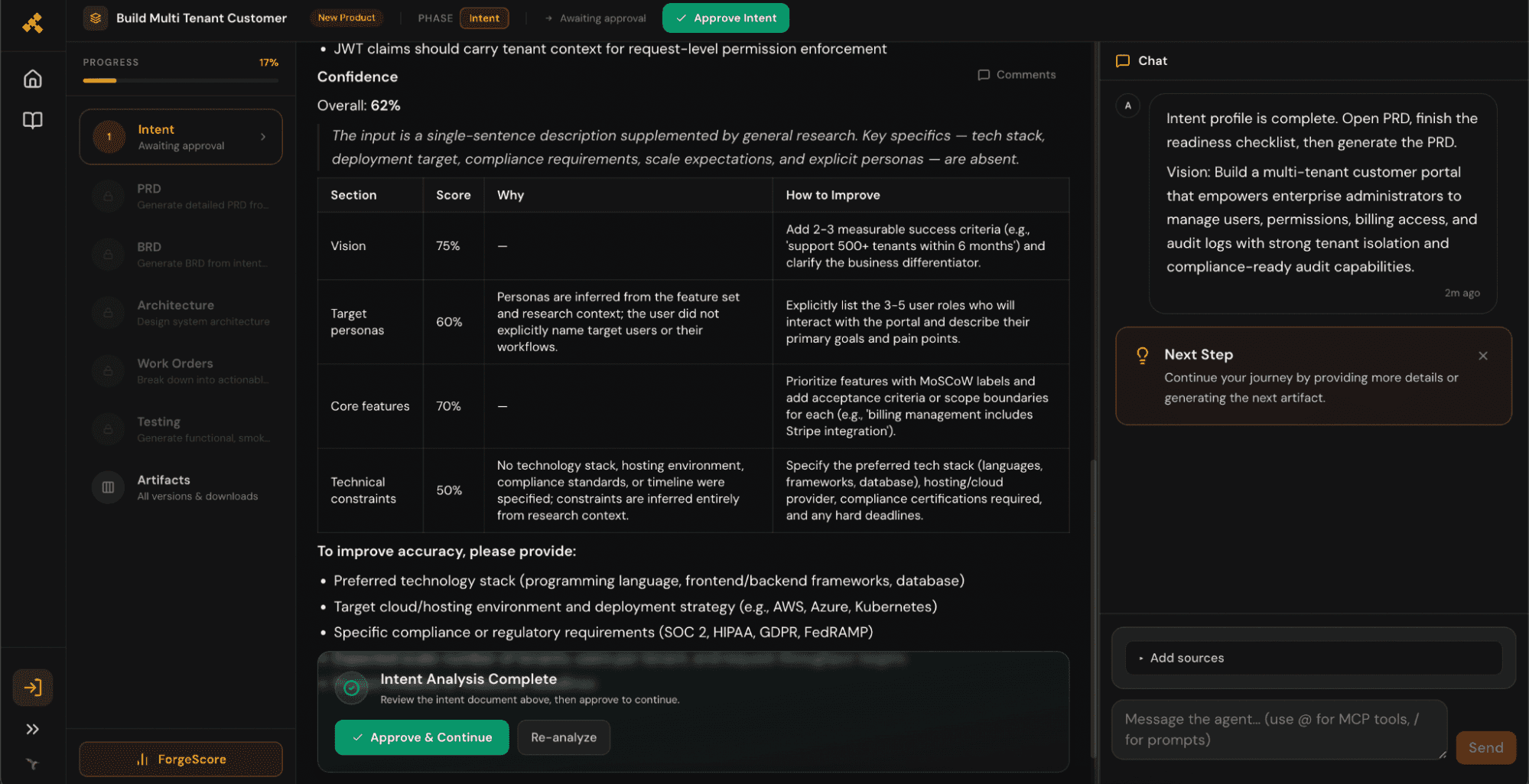
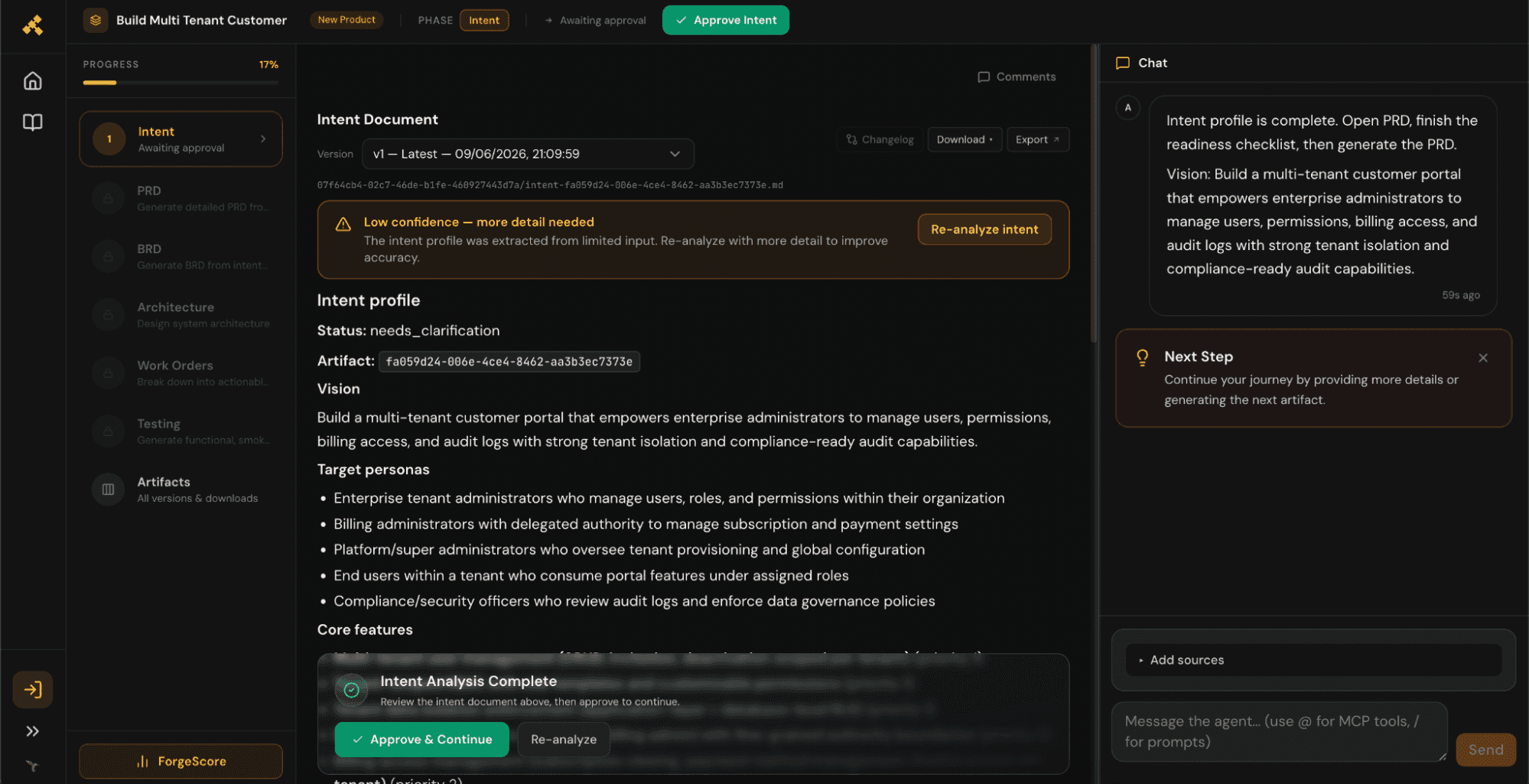
This dashboard illustrates the living Intent Document generated by SoftwareForge. It maps out the core vision, target personas, and features, and includes a flag for human review if the initial intent requires more structural detail to ensure execution accuracy.
Converting Intent Into Specifications
Once intent is captured and approved, the software factory generates the formal specification layer: PRDs, FRDs, user stories, API contracts, architecture diagrams, and security requirements.
GitHub's own analysis of spec-driven development notes that this approach succeeds where vague prompting fails because of a basic truth about how language models work: they are exceptional at pattern completion, but not at mind reading. A vague prompt like "add photo sharing to my app" forces the model to guess at potentially thousands of unstated requirements. Structured specifications eliminate the guesswork.
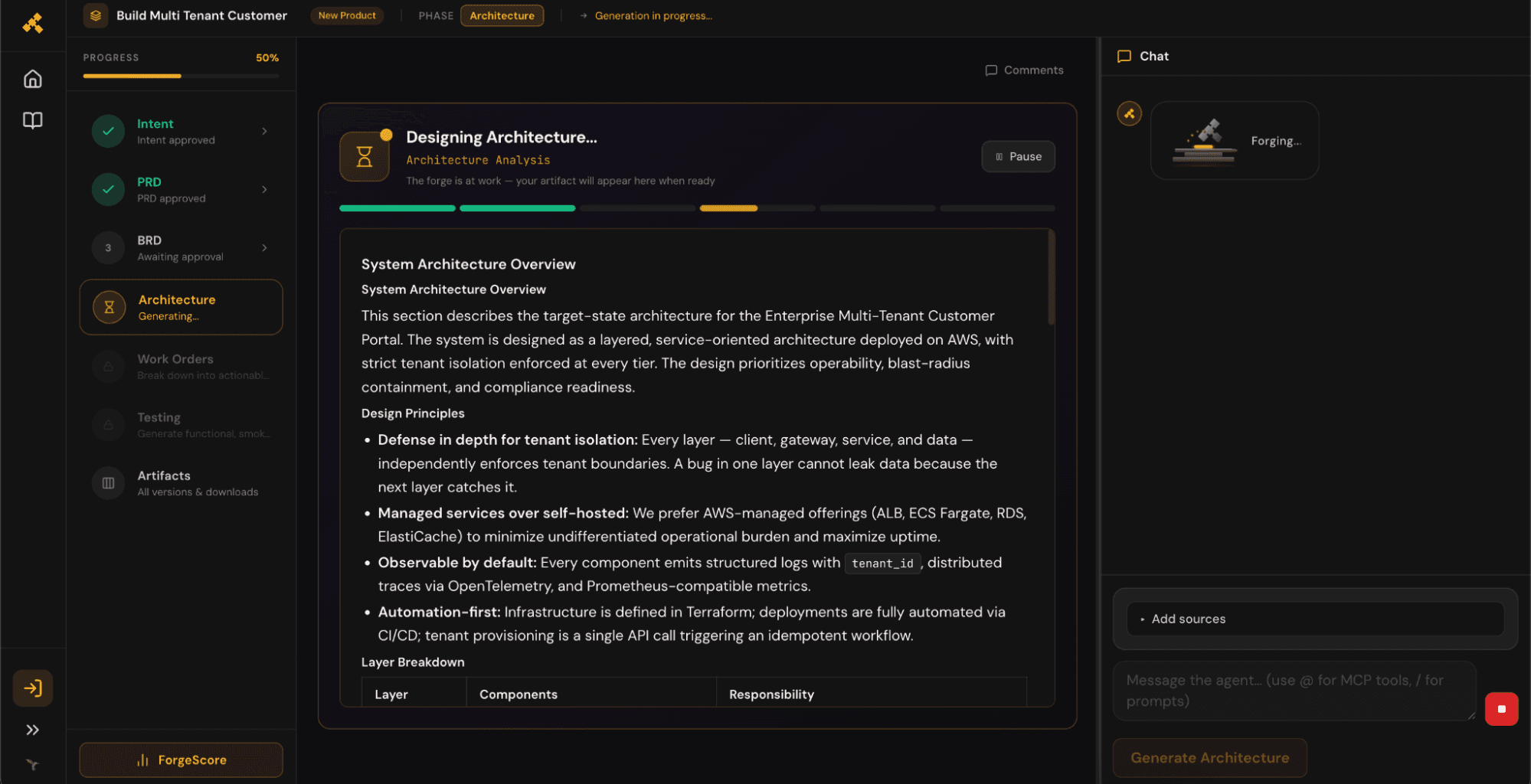
This interface shows SoftwareForge generating the System Architecture Overview. It explicitly documents design principles (such as tenant isolation and infrastructure-as-code mandates) into machine-readable specs before any execution code is generated.
The tradeoff between lightweight and formal specifications is real. A team building a small internal tool does not need a full BRD. A team delivering a payment-processing feature in a PCI DSS environment cannot skip the formal security requirements document. Software factories let teams calibrate specification depth against the risk and complexity of the change, with minimum viable specification thresholds configured per component classification.
Executing Changes Through Governed Work Orders
Approved specifications feed into work orders, which are the atomic execution units that AI agents receive. SoftwareForge enables humans to authorize agentic action via auditable work orders, making it impossible to ship unapproved or non-compliant code.
The governance model works because every work order carries its authorization chain. An agent receiving a work order knows who approved it, which spec it implements, which security review cleared it, and which architectural decisions constrain its output. When the agent finishes, the commit includes a reference to the work order ID, providing the compliance team with a direct link from the code change to the business requirement without manual annotation.
This screen details the generated Work Orders block. Each epic and story detail granular acceptance criteria (such as precise schema definitions or database constraints) that strictly limit what an AI agent is authorized to build.
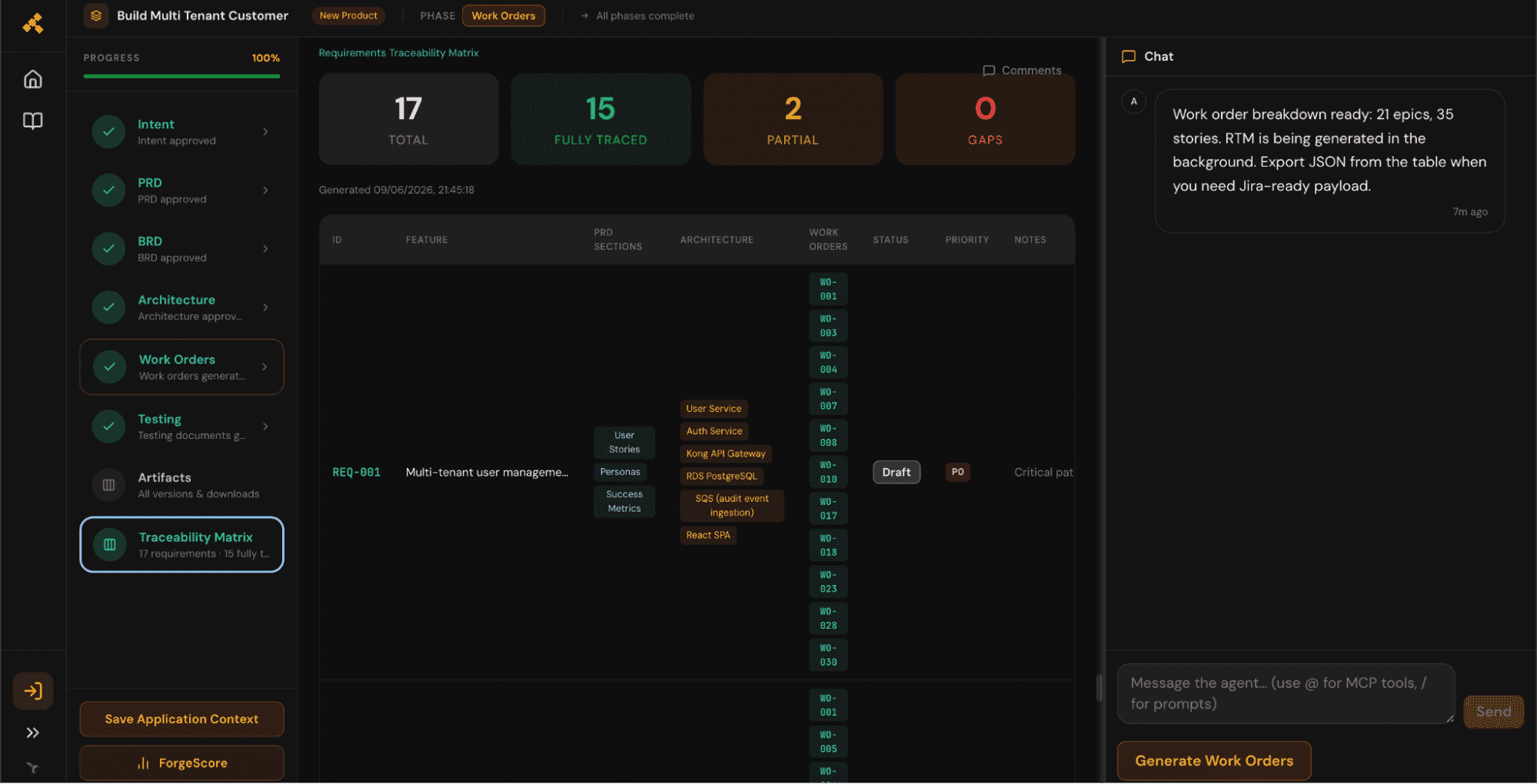
This view highlights SoftwareForge's automated Requirements Traceability Matrix (RTM). It provides a visual audit log tracing specific requirements (REQ-001) straight to the authorized Work Orders (WO-001), ensuring no unapproved changes slip in.
For regulated industries, the traceability a work order provides is not a convenience; it is an audit requirement. A financial services firm needs to demonstrate that code touching customer account data was reviewed by a security officer before deployment. With work orders, that evidence is generated automatically by the workflow. Without them, it has to be reconstructed after the fact, and that reconstruction is expensive and error-prone.
Architecture Patterns Behind Enterprise Software Factories
The workflow described above rests on three architectural layers that must be designed deliberately: where intent lives, how context is retrieved, and how execution agents interact with both.
Intent Store, Context Layer, And Execution Layer
The intent store is the system of record for all business objectives, constraints, acceptance criteria, and approval chains. It is version-controlled, machine-queryable, and bidirectionally linked to the specifications and work orders it produces. Every change to an intent artifact creates a new version, and agents always execute against a specific version rather than the latest mutable state.
The context layer sits between the intent store and the execution agents. It aggregates the architectural knowledge, security policies, coding standards, and interface contracts that an agent needs to execute a work order correctly. SoftwareForge builds a persistent context layer with security, policy, and rules to eliminate context rot and hallucinations, ensuring code remains stable and secure. The context layer is not a dump of every document in the company; it is a curated, indexed knowledge base that returns relevant context based on a work order's scope.
Managing multi-model setups requires a rigid separation of concerns. This minimalist flow maps the absolute boundaries between human intent and automated execution inside the factory.
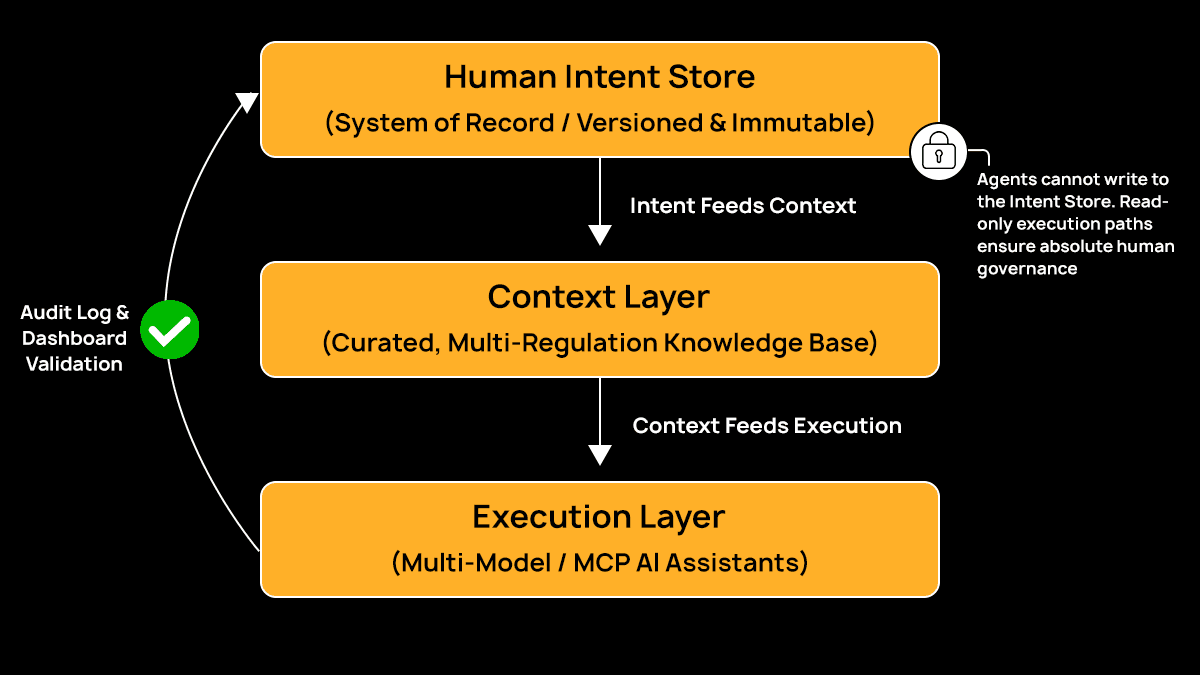
By defining execution as a strict, downward flow of constraints, the enterprise prevents autonomous agents from silently polluting architecture definitions or writing their own criteria.
Where Software Factories Change Delivery Economics
The economic case for a software factory is not primarily about generating code faster. It is about eliminating rework, coordination overhead, and remediation costs that accumulate when intent, context, and code drift apart.
New Application Delivery From Idea To Production
In a traditional multi-team delivery cycle, requirements gathering takes one to two weeks, architecture review takes another week, security review another, and by the time a developer writes the first line of code, three to four weeks have passed. Some of the original requirements have already shifted without the architecture document being updated.
Traditional workflows often address architectural alignment and compliance too late in the development cycle. The timeline schematic below details how moving specification generation upstream radically shortens release cycles.
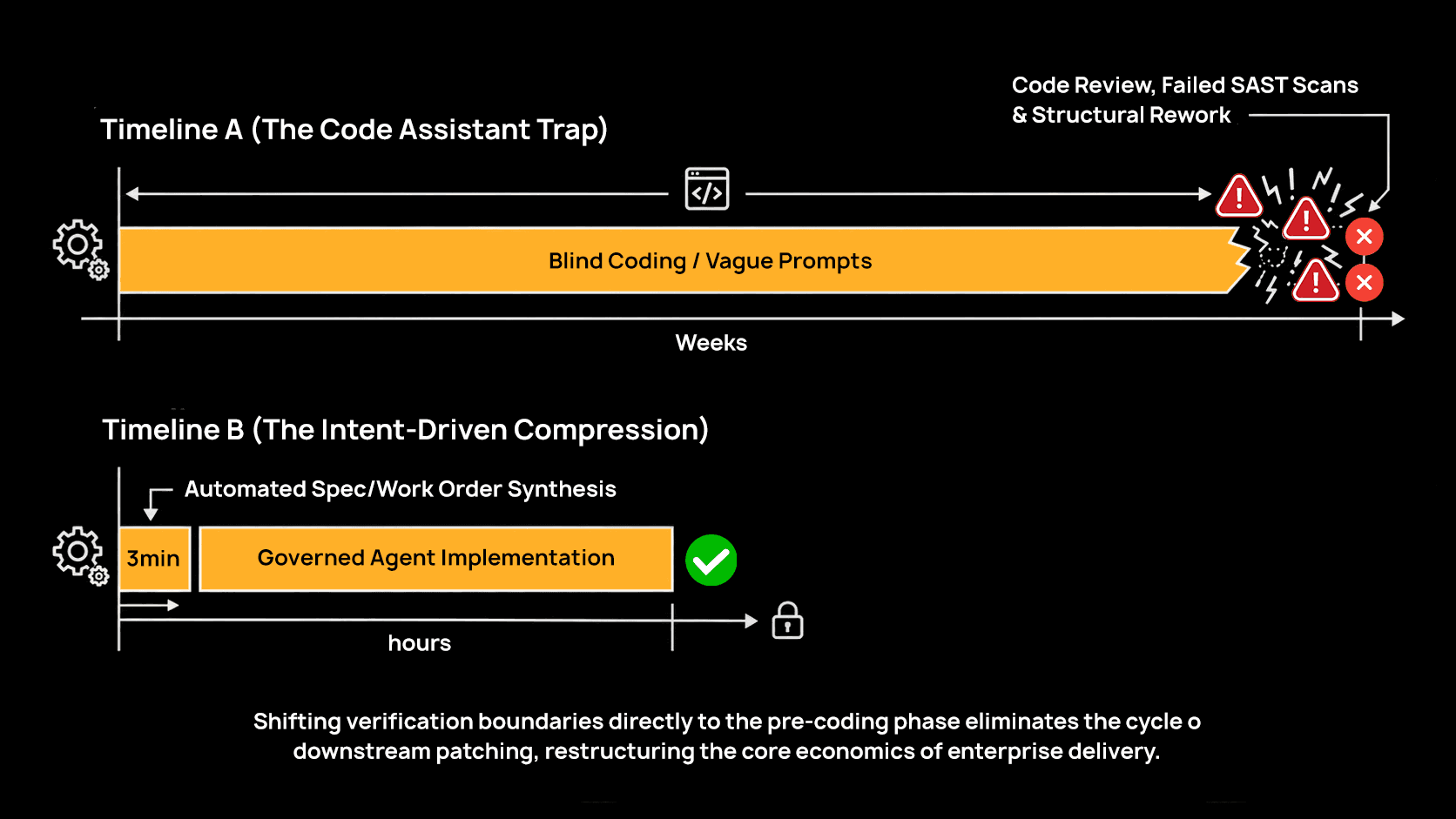
Shifting verification boundaries directly into the pre-coding phase eliminates the cycle of downstream patching and restructures the core economics of enterprise delivery.
A software factory compresses that upstream work from weeks to hours by generating requirements artifacts, architecture documents, security requirements, and work orders in a single governed flow, with specification generation taking approximately 3 minutes. The elapsed calendar time still depends on how quickly stakeholders review and approve the generated artifacts. Still, the labor cost of producing them drops significantly because generation is machine-driven based on captured intent.
The conditions required for those gains are worth stating explicitly. Teams need reusable platform standards already defined: approved technology stack choices, documented integration patterns, and a working policy engine. A software factory generates specifications against the constraints it knows about. If the approved architecture patterns do not exist in the context layer, the generated specs will reflect gaps rather than fill them.
Legacy Application Modernization
Legacy applications consume a significant share of engineering budgets because their original intent, architecture, and governance history are often undocumented. Most enterprise codebases are not clean microservice architectures with well-documented interfaces; they are decades of accumulated decisions spread across dozens of repositories, some with no documentation at all, some with documentation that stopped being accurate three major versions ago. Traditional modernization projects spend months reconstructing that system behavior before development can begin.
A software factory accelerates this process by reverse-engineering the existing codebase into living specifications. SoftwareForge can analyze .NET monoliths, COBOL mainframes, tangled Java services, and Angular-to-React migrations to regenerate documentation, architectural diagrams, and the business logic and context that was lost when the original engineers left.
It extracts business rules, creates governed modernization work orders, and infers formal API contracts from existing services, so teams can validate integrations against documented interfaces instead of relying on unpredictable legacy behavior. The recovered intent then carries forward into modern, AI-ready code.
This interface shows the factory's dedicated Modernize Legacy Code workflow, allowing teams to link existing Git repositories or local source folders to reverse-engineer behavior back into living specifications.
Before committing to a migration plan, SoftwareForge's ForgeScore delivers an 8-dimensional engineering health assessment covering security, architecture, performance, and AI adaptability in minutes, giving teams a starting point for understanding the scope of modernization work.
Parallelizing Work Without Losing Traceability
One of the compounding costs in large delivery programs is coordination overhead: teams waiting on each other, duplicating decisions already made elsewhere, and producing conflicting implementations that must be reconciled at integration time. A software factory establishes a shared source of truth between humans and AI through its intent store and specification layer, which allows multiple agents or engineering teams to work simultaneously without diverging on architectural decisions or compliance constraints.
When two agents are implementing different components of the same system, they both read from the same context layer. An architectural decision that states "all services use the internal event bus for cross-domain communication" is enforced in both work orders. Neither agent independently decides that an HTTP callback would be simpler. The merge-conflict consideration is real but manageable. Parallel work orders operating on different components should not produce conflicts. When they do, it signals that the scope boundaries in the work orders were not clean, which is a specification problem to fix before execution, not an integration problem to fix after.
Evaluating A Software Factory For Enterprise Adoption
Evaluating this category of tooling requires asking different questions than a typical developer tool evaluation. The technical capabilities matter, but so do the operational model and the factory's integration with existing governance structures.
Questions To Ask During A Proof Of Concept
Traceability: Can you trace a line of production code back to the business requirement that authorized it, through the approval chain, with timestamps and authorizing principals? If the answer requires manual reconstruction, the traceability is not real.
Context retention: Does the factory maintain context across sessions and across multiple repositories, or does each session start fresh? Ask for a demonstration of a brownfield codebase spanning multiple repositories.
Policy enforcement: Where in the workflow are policy violations detected? Ask to see a demonstration where a work order violates an organizational policy, and verify that the violation is caught before execution rather than after.
Rollback behavior: If a work order produces code that fails a post-deployment check, what does rollback look like? Is the rollback itself a governed work order, or is it an out-of-band manual process?
Artifact generation: Request samples of the PRD, FRD, architecture diagram, and Requirements Traceability Matrix that the factory generates for a representative request. The quality and completeness of these artifacts are the most direct evidence of whether the factory's specification generation will meet your engineering team's needs.
Integration scope: Ask specifically about your existing CI/CD stack, security scanner outputs, and change management tooling. Integration claims are easy to make and harder to verify; request a working demonstration against your actual toolchain during the POC.
Building Reliable AI Software Delivery Through Software Factories
Software delivery with AI agents producing code at volume runs into the same fundamental problem that handwritten code always did, just faster: requirements drift, architectural decisions get lost between teams, security constraints get forgotten when context switches, and rework accumulates until it becomes the dominant consumer of engineering time. This article covered how a modern software factory addresses that by treating intent as a versioned artifact, converting it into machine-readable specifications before any code runs, executing changes through governed work orders with full authorization chains, and maintaining a persistent context layer that keeps every agent grounded in the same architecture standards, security policies, and compliance requirements.
The 2025 DORA research found that AI adoption correlates with higher software delivery instability and more change failures when the surrounding engineering system is not designed to handle AI-generated output at scale. A software factory is the surrounding engineering system. The value is not in the specification documents themselves; it lies in the unbroken chain from business intent to deployed code that those documents enable.
FAQs
1. What Is A Software Factory In Modern AI-SDLC?
A software factory is an AI-driven engineering system that coordinates planning, coding, testing, documentation, security, and deployment from a single source of intent. Instead of assisting with individual coding tasks, it manages the entire software delivery lifecycle, maintaining shared context across workflows.
2. How Is A Software Factory Different From GitHub Copilot Or Other AI Code Assistants?
AI code assistants focus on generating code within an editor, while a software factory orchestrates end-to-end delivery across multiple engineering activities. It maintains context between tasks, applies organizational standards, and coordinates work beyond code generation.
3. Can A Software Factory Work With Existing CI/CD And Security Tools?
Yes. Most software factories are designed to integrate with existing CI/CD pipelines, version control systems, testing frameworks, and security scanners rather than replacing them. They extend established engineering workflows by adding AI-driven orchestration and automation.
4. When Does Intent-Driven Development Reduce Rework In Enterprise Software Delivery?
Intent-driven development reduces rework when business requirements, architecture, implementation, testing, and documentation stay aligned from the beginning. Shared intent minimizes misunderstandings, duplicate work, and late-stage changes caused by inconsistent requirements.


