Blog / AI-SDLC
Legacy Code Modernization Without Breaking Business Logic


Nasssir Khan
Head of Product Marketing & GTM
TL;DR
A migration tool can convert syntax in an afternoon, but it cannot tell you why a loop skips every third record when an account flag is set, because that rule was never written down anywhere except in the loop itself. Modernization fails when teams treat translation as a substitute for understanding.
Architectural drift rarely comes from one bad decision. It comes from several agents or engineers each making a locally reasonable call on the same shared dependency, with no shared view of what the others are doing, until the conflict surfaces weeks later in production.
Characterization tests turn undocumented behavior into an enforceable contract. Once a baseline exists, every later change gets checked against what the system did, not against what someone assumed it was supposed to do.
A health score only earns its keep if it changes the order work gets done in. Ranking modules by measurable risk, not by who complains loudest, is what separates a governed modernization plan from a backlog reshuffle.
An unreviewed work order is a bigger liability than an unreviewed pull request, because it can touch a dozen files before anyone sees a diff. Scoping the unit of change before generation starts is what makes the resulting audit trail worth anything.
Modernization does not end at cutover. A system that returns to its old failure patterns eighteen months after go-live was never modernized, it was translated, and the difference only shows up on the next incident.
Why Legacy Systems Become Hard To Change
Legacy code modernization is the practice of changing how an existing production system is built, its language, framework, data layer, or architecture, while keeping the business rules that system enforces intact. That is a different exercise than translating COBOL syntax into Java syntax or bumping a Rails application to a newer major version. A migration script can convert a PERFORM loop into a for loop in an afternoon. It cannot tell you why that loop skips every third record when a specific account flag is set, because that behavior was never written down anywhere except inside the loop itself.
Interest in this work has climbed since AI-assisted development moved past autocomplete into full agentic coding. Forrester's 2025 Technology Predictions found that 75% of technology decision-makers expect their technical debt to reach moderate-to-severe levels by 2026, driven in large part by AI-assisted development moving faster than the governance built to manage it. Engineers discussing legacy ownership on a DEV Community thread converge on the same point from the maintenance side: legacy code does its job even when it looks broken, and the first move has to be protecting that behavior with tests before anyone touches the internals, not replacing the system on the assumption that a clean rewrite will reproduce what the old one did by accident.
Syntax translation, AI-assisted or not, does not close that gap. The cost shows up as undocumented dependencies nobody mapped, business rules that exist only inside a stored procedure, integrations held together by a service account with a password nobody rotated, and knowledge that lives entirely in the head of one engineer who changes teams next quarter. This article covers where modernization projects fail before a single line changes, how teams reconstruct system behavior before touching production code, and how SoftwareForge governs that process with ForgeScore, Living Specifications, and Work Orders.
Most modernization failures get diagnosed after the fact as a testing gap or a scheduling miss. The actual failure happened earlier, at the point where someone decided the system was understood well enough to start changing it.
Hidden Business Logic Buried Inside Legacy Systems
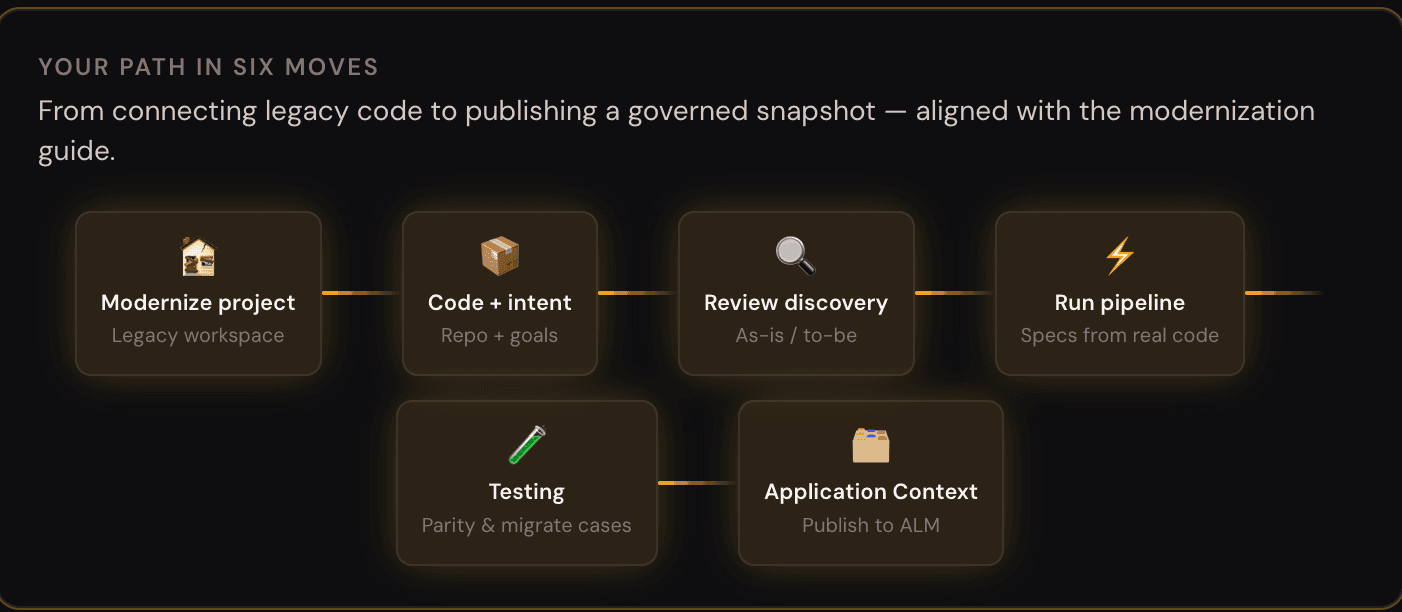
A rule that says premium accounts skip the fraud queue on weekends rarely lives in a requirements document. It lives in a conditional buried three functions deep, written by someone who left the company, triggered by a flag nobody remembers the origin of. Static code conversion tools read syntax and produce equivalent syntax; they have no mechanism for asking why the conditional exists, so the translated system either keeps a rule nobody can explain or silently drops one that matters. SoftwareForge's Legacy Code Assessment scans the repository before any transformation begins, building a Knowledge Graph that exposes relationships between modules, data flows, external services, and business logic. Instead of leaving those dependencies buried inside individual files, the relationship views surface them as connected system components, giving engineers a view of how a change in one area propagates through the rest of the application before modernization work starts.
Missing Context Creates Architectural Drift During Refactoring
Systems that have passed through four or five engineering teams accumulate architecture the way old houses accumulate additions: each one made sense to whoever built it, and none of them talked to each other. Dependency graphs grow tangled, modules get abandoned mid-migration, and interfaces exist that nothing in the current documentation references. Rebuilding architectural intent from interviews and tribal knowledge does not scale past a handful of services, because the people who made the original decisions have usually moved on. SoftwareForge's Living Specifications exist to replace that reconstruction exercise with a persistent, versioned record: a machine-readable document that captures business objectives, functional requirements, security obligations, and an explicit out-of-scope boundary, reviewed and approved by a human rather than assembled from memory after the fact.
Reconstructing System Behavior Before Changing Production Code
Behavioral reconstruction is the step teams skip when a deadline is tight, and it is the step that determines whether the rest of the project goes smoothly or turns into a six-month firefight. Two disciplines make up the bulk of it: tracing what the system does at runtime, and locking that behavior down before anyone starts changing code underneath it.
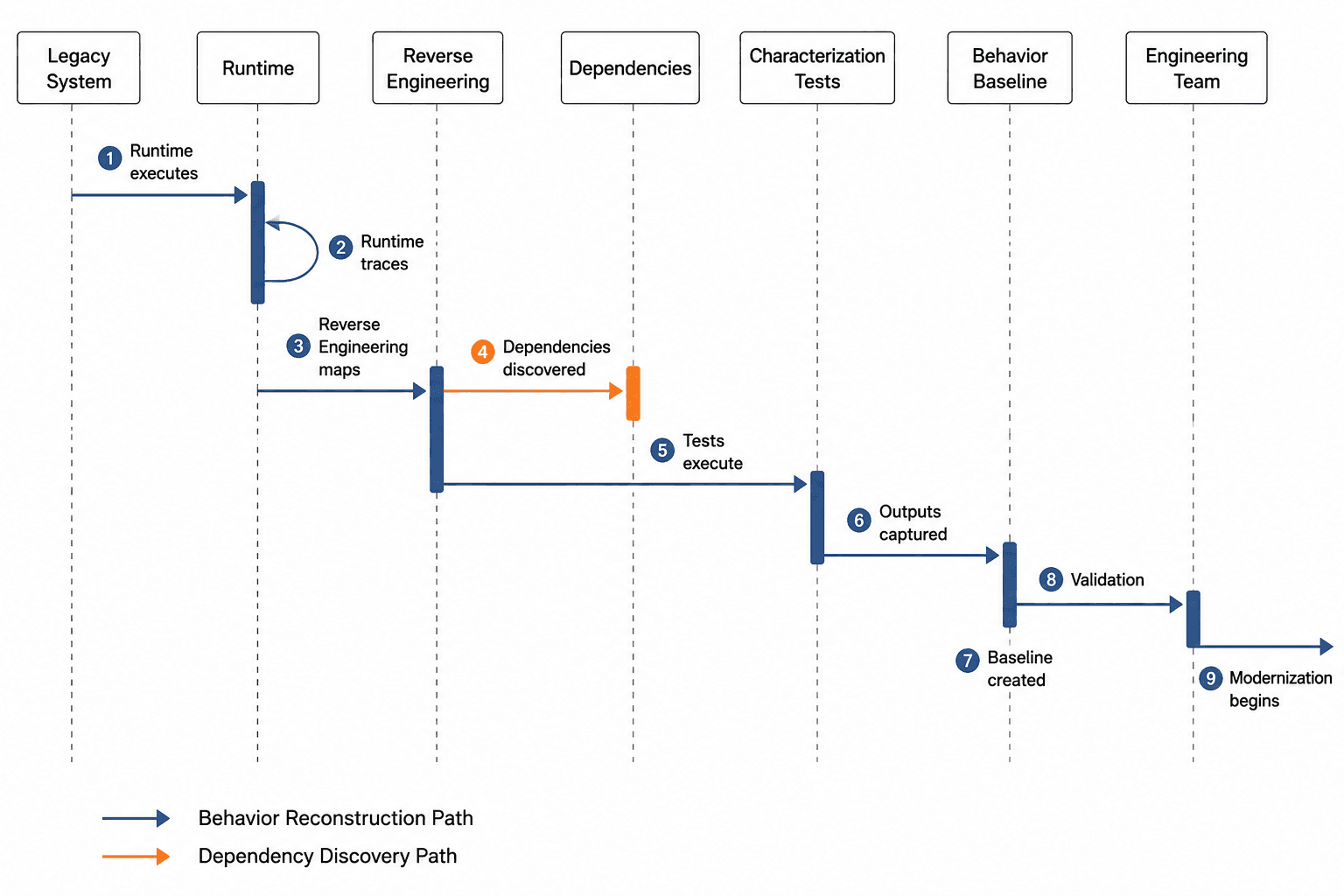
Follow the runtime trace first because every later activity depends on it. The dependency discovery branch is easy to misread as optional even though it feeds the baseline before modernization starts.
Reverse Engineering Beyond Static Code Analysis
Static analysis reads source files. It does not read the configuration file that overrides a timeout in production, the database trigger that fires on update, or the third dependency four levels deep in a transitive tree that nobody remembers importing. A coding agent asked to add an integration to a payment service can pull in a legitimate SDK that transitively depends on a vulnerable authentication library, four levels down, with no visibility into that chain at the point the pull request gets opened. SoftwareForge's blog post on technical depth in AI-SDLC documents exactly this scenario: a Buy-Now-Pay-Later integration pulled in a dependency carrying a CVSS 9.8 JWT bypass, one that a container scan and an unmerged Dependabot pull request had already flagged eleven days earlier in two different systems that never talked to each other.
Reconstructing that kind of chain by hand does not scale across a system with eight independently managed services. The command below shows the manual starting point engineering teams use before any AI-assisted or governed approach replaces it, useful here because it demonstrates exactly how much of this work static analysis alone leaves undone.
cd services/paymentservice |
Each mvn dependency:tree run for a single service can return several hundred lines, with the vulnerable package sitting somewhere in the middle, unlabeled and indistinguishable from any other transitive dependency until someone checks it manually. That is the gap SoftwareForge's ForgeScore and Living Specification workflow closes: a scan of the repository builds the dependency and behavior map once, at the organization level, so an agent implementing the next feature starts from a record that already flags which packages carry known vulnerabilities instead of rediscovering the problem service by service.
None of this shows up in a thirty-second demo of an agent scaffolding a CRUD API. A demo and a production system look identical until three sprints later, when a query against the live cluster turns up a service account with cluster-wide access to secrets that nobody authorized.
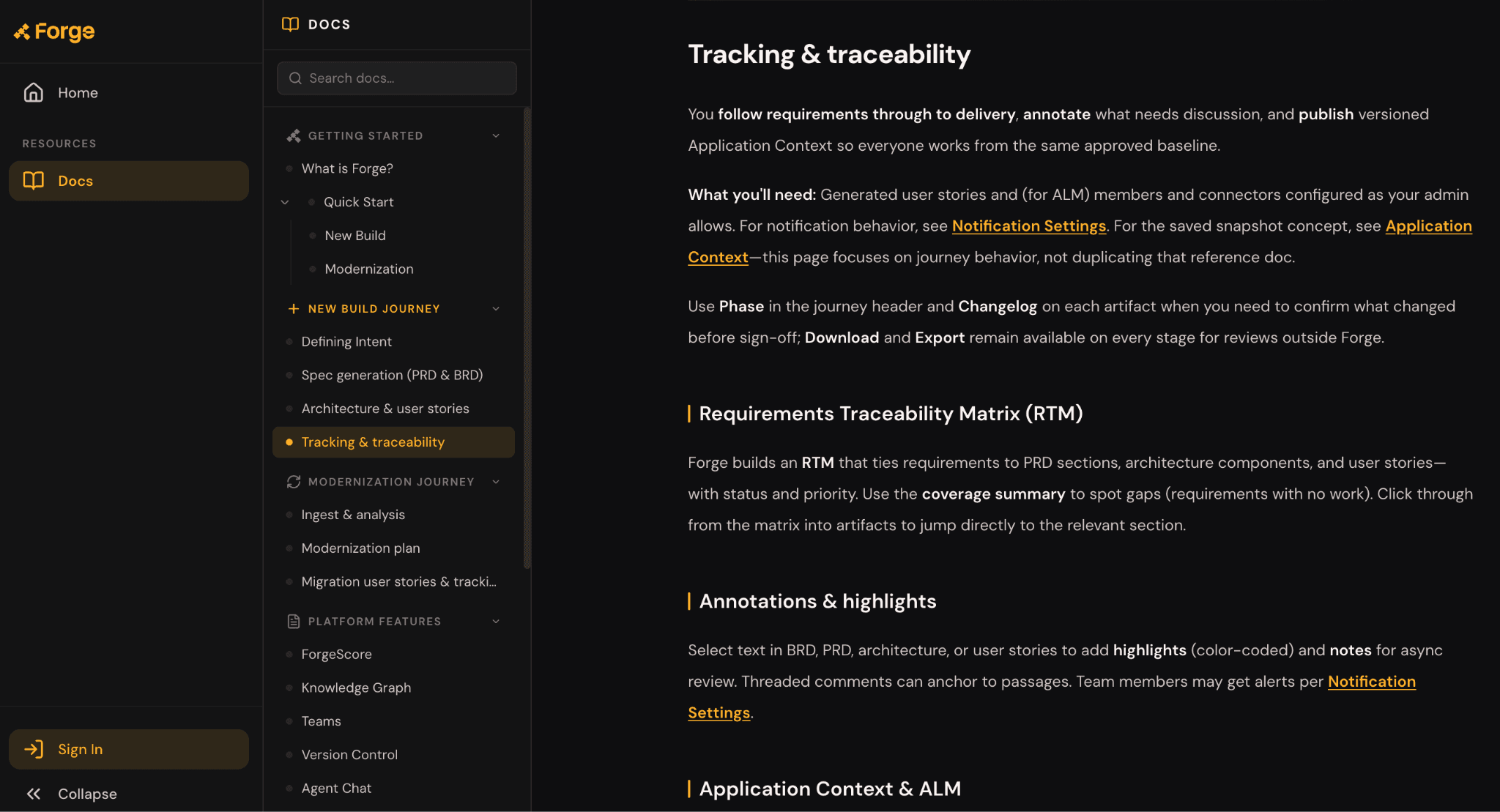
That fragmentation is not a tooling failure in the way it first looks. Each scanner does exactly what it was built to do. The problem is that nothing connects the three results into one picture an engineer can act on without manually cross-referencing line 287 of a 340-line dependency tree against a CVE database by hand.
Characterization Tests Define Safe Modernization Boundaries
A characterization test, a term Michael Feathers coined and popularized through Working Effectively with Legacy Code, does not check that code does what it is supposed to do. It checks that code keeps doing what it currently does, recording actual behavior for a given set of inputs so that any later change can be measured against that recorded baseline instead of against a specification that may never have existed. Writing one for an undocumented function forces the person writing it to observe real outputs for real inputs, which is often the fastest way to discover a business rule that no design document mentions.
Once a baseline exists, it becomes the acceptance contract for the rest of the migration. API responses from the new implementation differ against recorded responses from the old one. Incremental replacement becomes possible because each swapped component has a test proving it produces the same output the retired component did, not just that it compiles and passes its own unit tests. Generated code, whether written by a human or an AI coding agent, still needs this verification step; passing an agent's self-written test suite says nothing about whether the agent's implementation matches what the legacy system did in production.
Governing Legacy Code Modernization Across Every Transformation Stage
Behavioral reconstruction tells a team what a system does. Governance is the separate discipline of deciding, in an auditable way, who gets to change that system and under what constraints, and it needs three connected layers to hold up under real engineering load.
ForgeScore Identifies Technical Debt Before Code Changes
Subjective prioritization, the loudest team's service gets modernized first, does not survive contact with a portfolio of forty applications. ForgeScore is SoftwareForge's eight-dimension health assessment, evaluating a codebase across security, architecture, performance, and AI adaptability before any migration plan gets written. A team points the assessment at a GitHub repository and a project name, and the platform returns a measurable baseline instead of a gut-feel ranking.
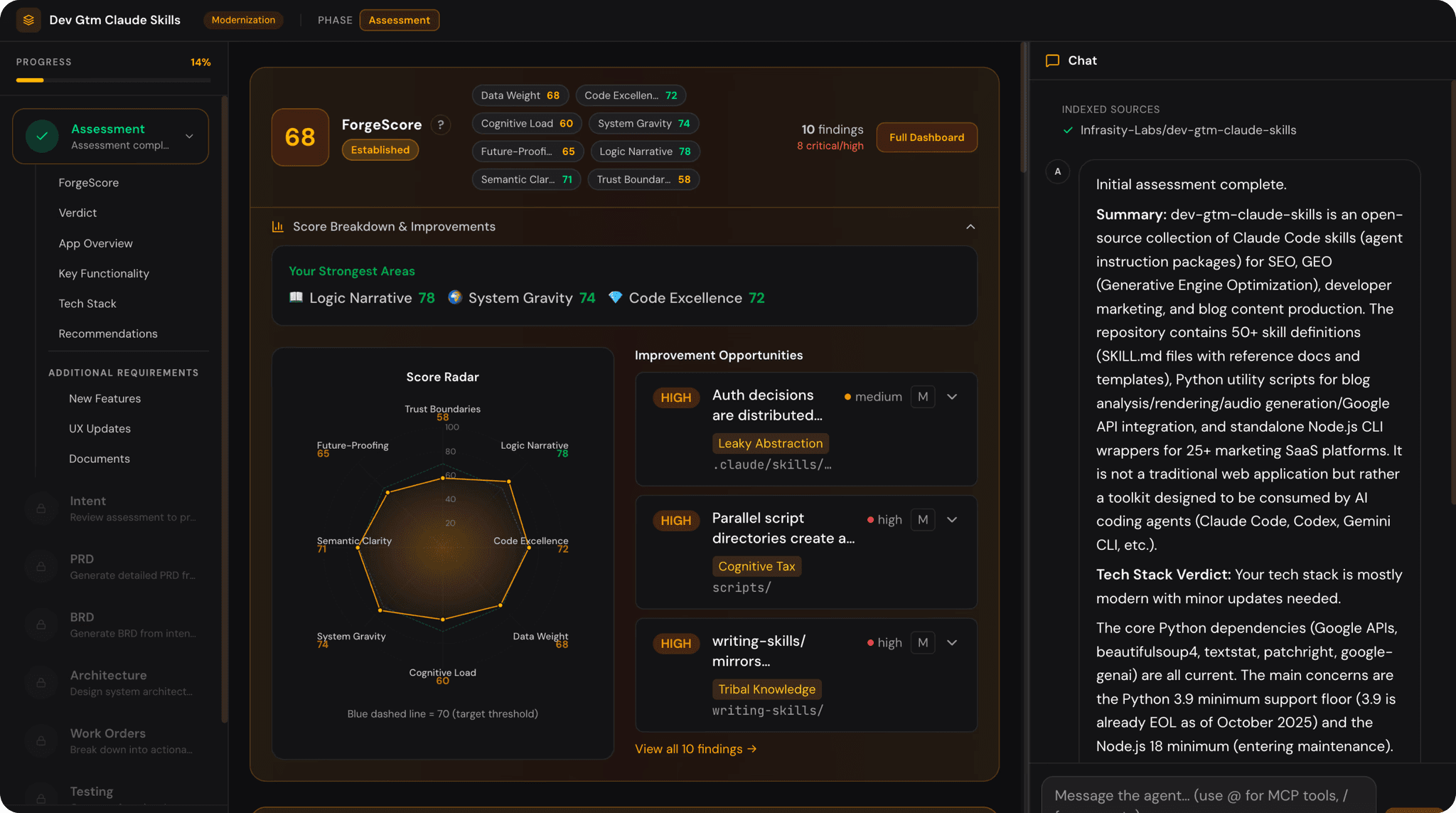
The score only earns its keep if it changes the sequence of work. A module with a critical CVE and low architectural complexity gets remediated before a module that is merely old but stable, because the health data makes that priority defensible to a compliance reviewer, not just convenient for the engineer who happened to be free that sprint.
Work Orders Create Auditable Modernization Decisions
An agent given broad repository access and a loosely worded goal has no natural stopping point. If it can read and modify anything in pursuit of "clean up the checkout flow," the only review checkpoint is the final diff, by which point it may have touched a dozen files to do what the original ticket asked for in two. A Work Order, as SoftwareForge implements it, is the mechanism that constrains that blast radius before generation starts rather than after.
Business Goal: "Reduce support tickets for permission issues" |
Each row in that chain traces back to the one above it, adapted here from the traceability model SoftwareForge documents in its AI-SDLC overview. When an on-call engineer needs to know why a service enforces a particular token expiry, the answer is a specific line in a document still in active use, not a Slack thread from eight months earlier that half the participants have since forgotten.
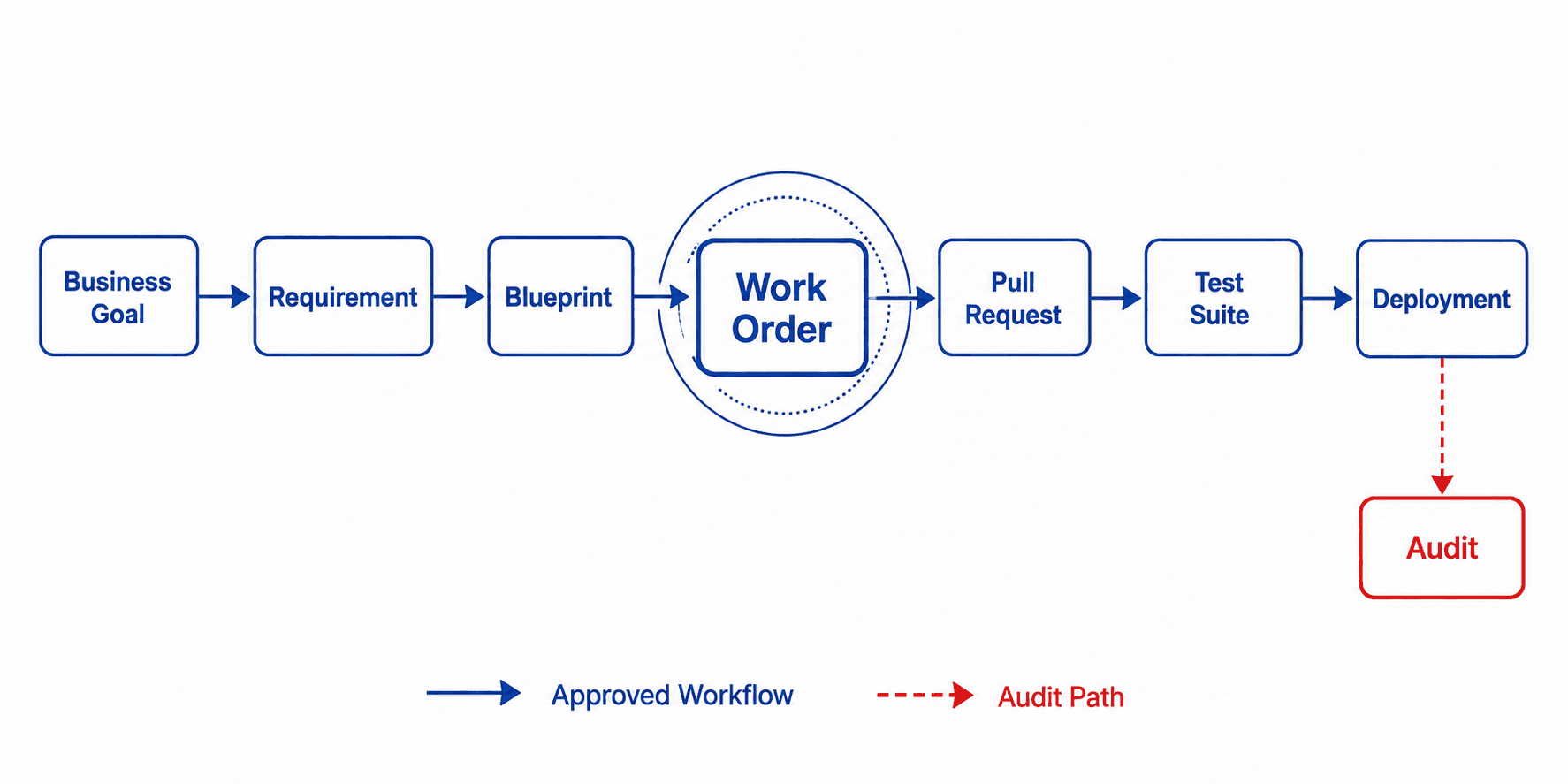
Start with the Work Order because every approval path converges there before code generation begins. The audit connection after deployment is the easiest relationship to overlook because governance continues beyond release.
Persistent Context Prevents Repeated System Rediscovery
Stateless agent sessions read whatever files a task needs, make a change, and end with no memory of what came before. The next session starts blind to yesterday's decisions, which forces every engagement with a legacy system to rediscover context that was already found and then discarded. A persistent context layer keeps the architecture, the policy set, and the requirements addressable across every stage of the pipeline, so a coding agent picking up a work order against a payment service already knows the service sits in PCI-DSS scope, that card data cannot be stored, and that the build pipeline rejects anything carrying a CVE above medium severity, without a human re-explaining any of it.
GET forge://workspace |
That workspace reference has to reflect live repository state rather than a cached snapshot, because a compliance review conducted against an index that is even an hour stale can miss a dependency added that morning, or assume an authentication check still exists after someone quietly removed it. Governance decisions made against a version of the system that no longer exists are how audit gaps accumulate faster than anyone tracks them.
Choosing Between Refactoring, Migration, And Incremental Replacement
Refactor versus rewrite gets framed as a binary more often than the underlying decision is one. The variable that matters most is not developer preference. It is how much of the system can keep running unmodified while a smaller piece changes underneath it.
When Incremental Modernization Beats Complete Rewrites
A strangler-style migration routes new traffic to a modern replacement service one endpoint at a time while the legacy system keeps serving everything not yet migrated, which means a defect in the new checkout flow affects checkout, not the entire application. Complete rewrites remove that safety margin. Two systems have to be maintained in parallel until cutover, rollback means reverting an entire release rather than a single route, and the team loses the ability to validate the new implementation against live production traffic incrementally. Deployment cadence tends to favor the incremental path for any system where downtime carries a direct revenue cost, because each migrated slice ships and gets validated independently instead of waiting for one large release to prove itself all at once.
Where AI-Assisted Legacy Code Modernization Still Needs Human Review
Coding agents handle repetitive, well-specified work reasonably well: generating documentation from existing code, writing boilerplate test scaffolding, converting one well-understood pattern to another across many files. They perform worse on judgment calls that carry consequences an agent cannot be held accountable for. Deciding that a compliance-mapped audit trail needs to survive a policy change six months from now, or that a service handling regulated data needs a specific architectural boundary, requires someone whose name is on the decision. Positioning generation as governed execution, work authorized through a reviewed and scoped work order, rather than autonomous replacement, is what keeps that line intact instead of quietly eroding it one convenient shortcut at a time.
Measuring Legacy Code Modernization After Production Deployment
A successful migration and a successful modernization are not the same claim. The first means the new system shipped. The second means the new system behaves better than the old one over multiple release cycles, not just on launch day.
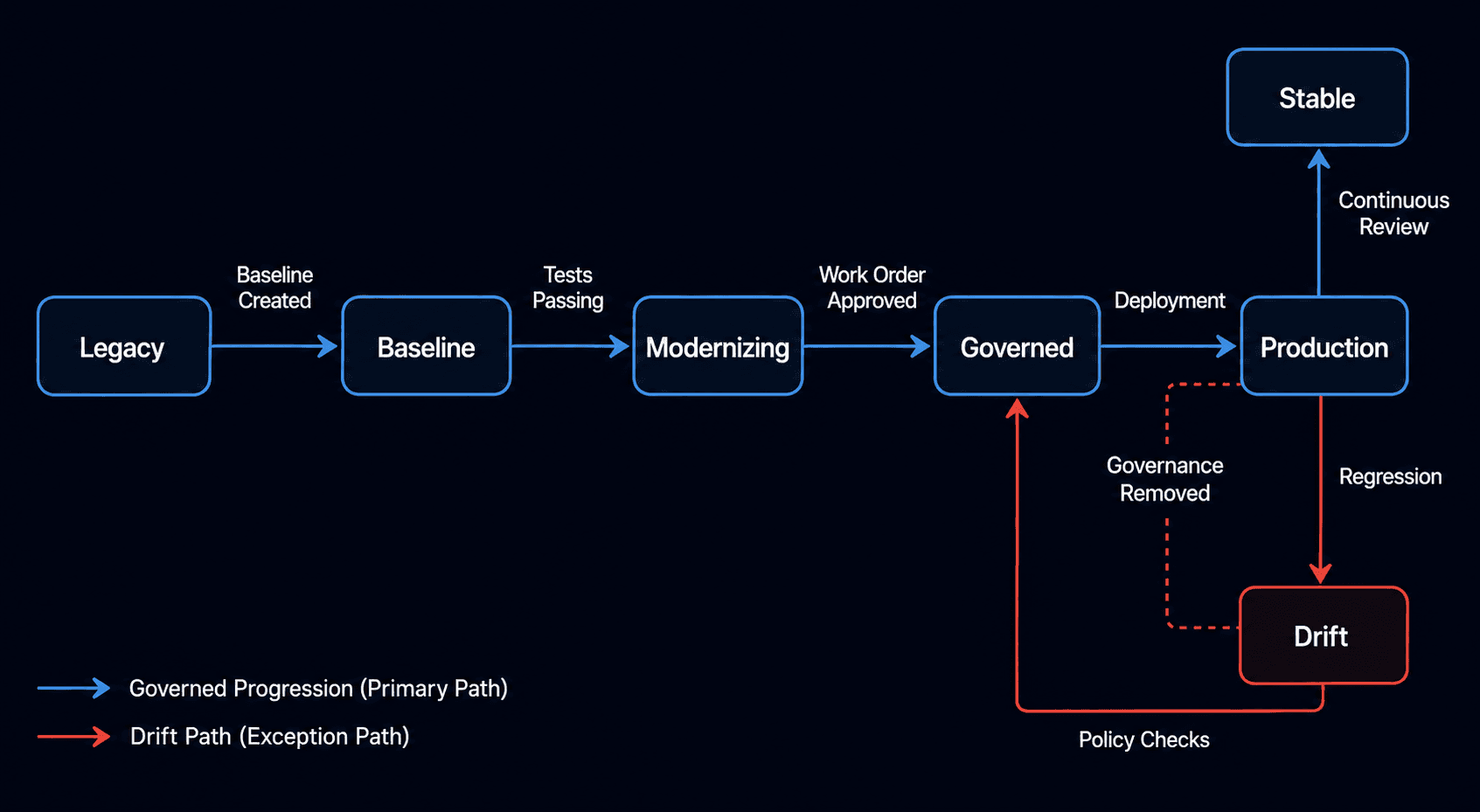
Trace the primary state path from Legacy to Stable before looking at the exception path. The Drift state is easiest to misread because it can occur after successful deployment rather than after a failed migration.
Technical Metrics That Reflect Modernization Progress
Dependency reduction, test coverage growth, deployment frequency, regression rate, and architectural consistency tell a more honest story than a generic velocity dashboard, because they measure whether the system got easier to change safely rather than whether tickets closed faster. A team that ships the same feature velocity as before modernization, but now with test coverage at 80% instead of 22% and regression incidents cut in half, has modernized something real. A team whose deployment frequency spiked immediately after cutover and then flattened within two sprints is watching a honeymoon effect, not durable progress, and the difference only becomes visible if someone is still measuring three releases later instead of closing the project at go-live.
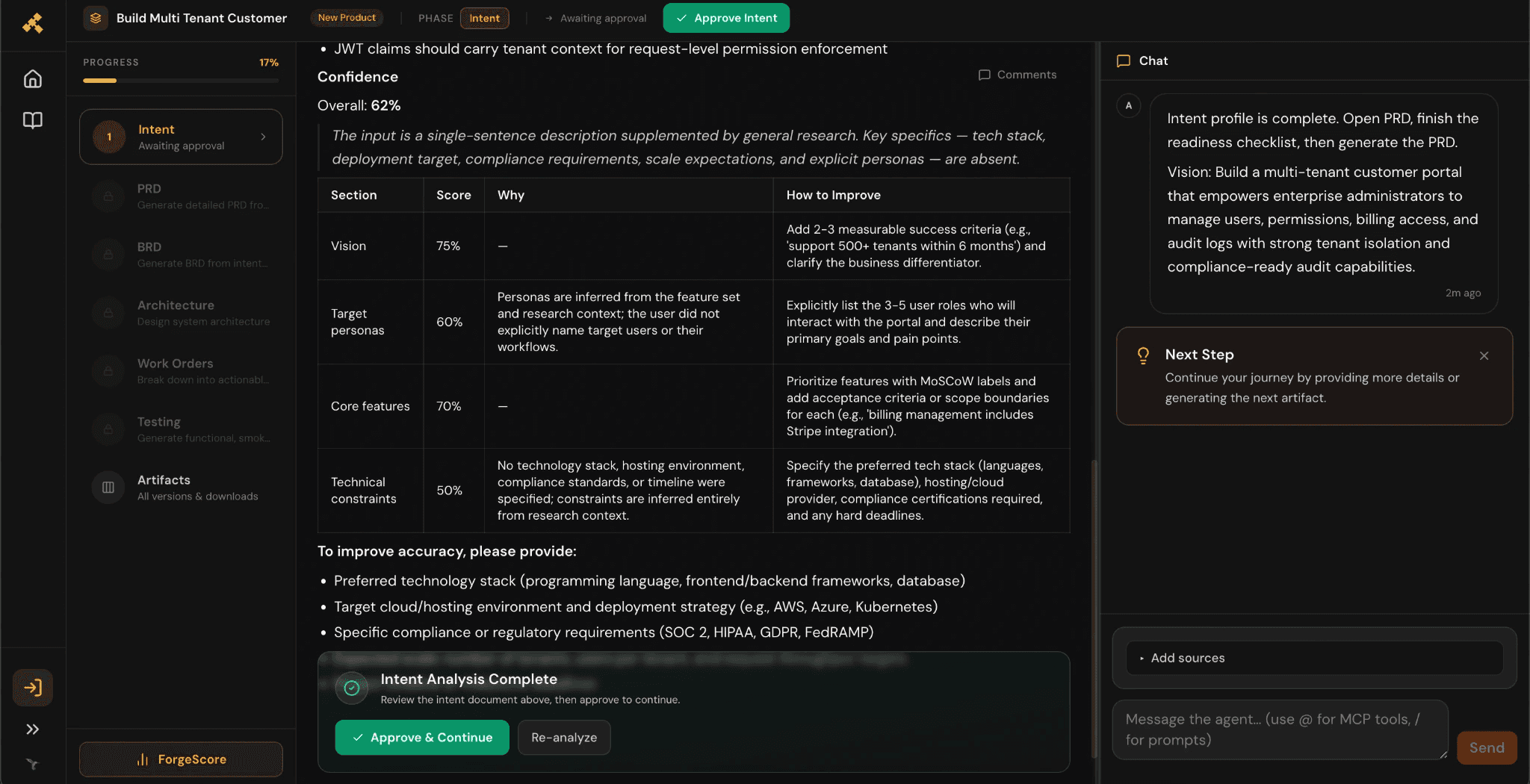
A work order execution record links a merged pull request back through its originating architecture blueprint to the business requirement that authorized it, forming an unbroken chain from intent to deployed code. Look at how the audit trail persists after deployment rather than existing only during the review stage, which is what lets a team answer a regulator's question about a specific line of production code months later.
Operational Signals That Reveal Remaining Legacy Risk
Recurring production defects in the same subsystem, undocumented workflows that keep surfacing during incident response, manual interventions that never got automated away, and onboarding time for new engineers that has not dropped, all point to legacy risk that survived the migration rather than legacy risk that got addressed by it. Continuous governance is what keeps a modernized system from drifting back into the same maintenance pattern that made it legacy in the first place: policy checks and architectural review that run on every change, not a one-time audit performed at the moment of cutover and never repeated.
Making The Right Legacy Code Modernization Decision
The decision that determines whether a modernization project succeeds gets made before any code changes, when a team chooses whether to reconstruct system behavior first or trust that translation will preserve it. Static conversion misses the business rules that were never documented anywhere except inside the code itself. Characterization tests turn undocumented behavior into a contract the rest of the project can be measured against. Governance, a measurable health baseline, scoped and auditable work orders, and context that persists across every stage, is what keeps that contract intact from the first scan through production deployment, rather than degrading the moment the migration ships and everyone moves on to the next project.
Legacy code modernization succeeds when engineering work starts from behavior rather than implementation. User stories grounded in verified business workflows give teams a way to capture intent before code changes begin, while characterization tests confirm that intent still holds after each change. When user stories remain connected to architecture, requirements, work orders, and deployed code, modernization becomes an incremental engineering process instead of a high-risk rewrite. A legacy system becomes maintainable when every production behavior can be traced back to a documented user need rather than inferred from the code alone.
FAQs
How Do You Modernize Legacy Code Without Breaking Existing Functionality?
Reconstruct actual system behavior before changing anything, using characterization tests to record what the current system does for real inputs. Treat that recorded baseline as the acceptance contract for every subsequent change, and validate incremental replacements against it rather than against assumed intent.
Should Legacy Applications Be Rewritten Or Refactored?
It depends on how much of the system can keep running while a piece changes. Incremental replacement fits systems where downtime carries direct cost; a full rewrite fits only when the underlying architecture no longer matches business needs and refactoring cannot close that gap.
How Is Legacy Code Modernization Different From Refactoring?
Refactoring improves the internal structure of existing code while preserving its external behavior and usually stays within the current architecture. Legacy code modernization covers a broader effort that may include replacing frameworks, migrating runtimes, restructuring data layers, introducing new deployment models, or incrementally replacing services, while preserving the business behavior the application already delivers. Refactoring is one technique within a modernization program, not a replacement for it.
Can AI Modernize Legacy Code Without Human Review?
No. Coding agents handle repetitive translation and documentation generation well, but architecture decisions, compliance mapping, and risk tradeoffs need a named, accountable reviewer. Governed execution, work authorized through a scoped and auditable work order, is what keeps agent-generated changes safe to ship.


